Rooftop Tents, Awnings and Camp Setup for Trucks and SUVs
7 min read
The short answer
A rooftop tent turns your truck or SUV into a basecamp that sets up in minutes and keeps you off the ground. Before you buy one, check three things: your roof or rack's load rating, the tent's weight, and how tall the whole setup will stand on a lifted vehicle. Add an awning for shade and rain cover, and plan storage and power so camp stays comfortable. Choose camping gear for the trips you really take, not the trips you imagine.
This guide is part of our accessories guide. We skip wheels, lift and tires because most Lifted Trucks builds already include them, though lift height changes how you reach and use a rooftop tent, which we cover below.
In this article
Who is camp gear for?
- Weekend campers who want fast setup and a comfortable bed.
- Overlanders who travel for days and camp in different places.
- Road-trippers who want to skip hotels and campground reservations.
- Hunters, anglers and photographers who start early at remote spots.
- Families who want a flexible, vehicle-based camping option.
If you camp only a few times a year, a ground tent may serve you well. A rooftop tent pays off when you camp often and move between sites.
Rooftop tents
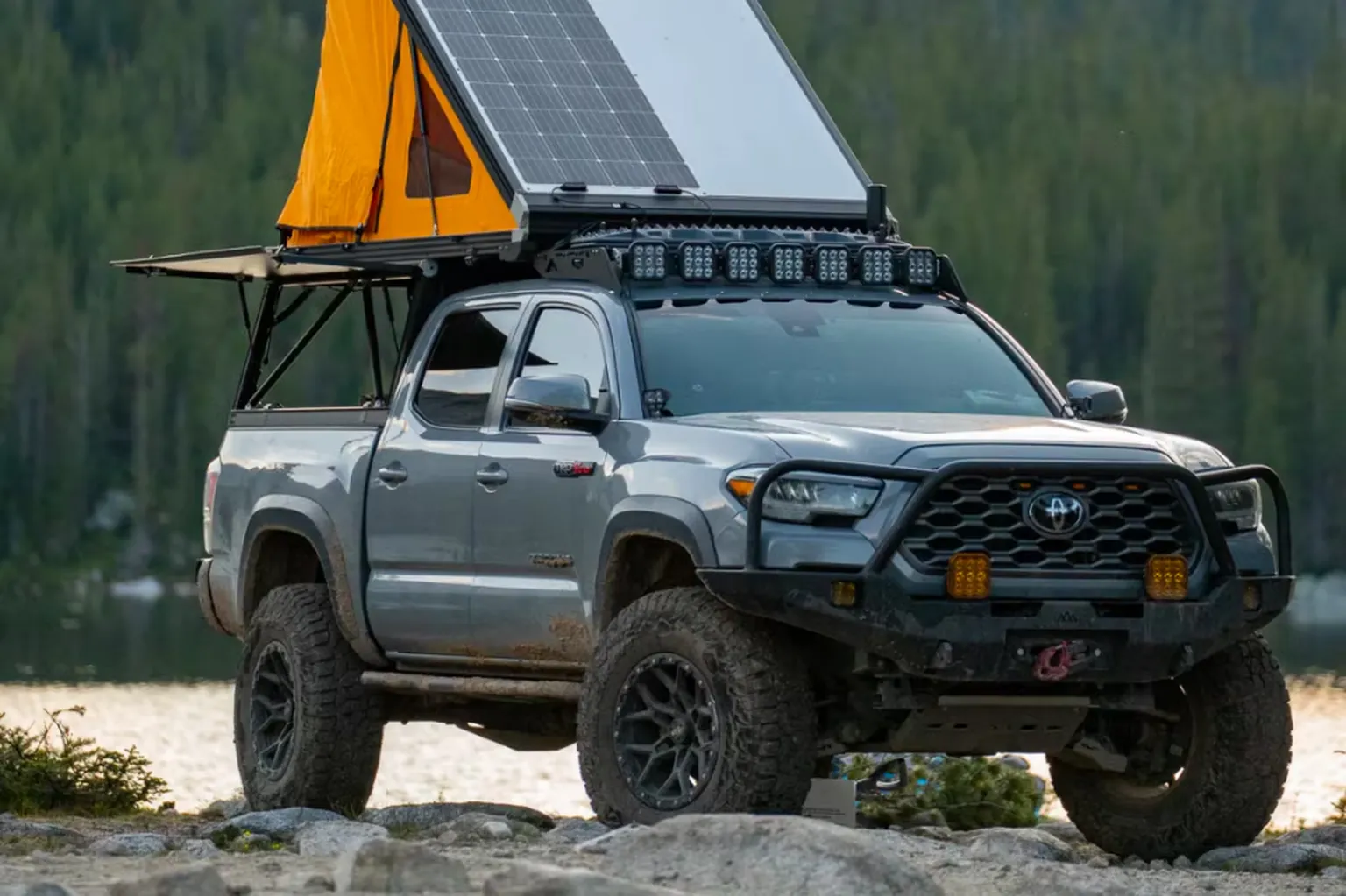
A rooftop tent mounts to a rack on the roof and unfolds into a sleeping space above the vehicle.
Hard shell rooftop tents
A hard shell tent has a rigid lid that lifts or pops up.
Pros: Fast setup, durable in wind and weather, and a lower profile when closed, which usually helps with wind noise.
Cons: Typically heavier and costlier than soft shell models.
Best for: Frequent campers, cold or windy conditions and quick overnight stops.
Soft shell rooftop tents
A soft shell tent folds out, often with a ladder and an annex or extra covered space.
Pros: Often more interior room and sometimes lighter, with some models offering a large covered area.
Cons: Setup can take longer, and the folded tent is bulkier and often catches more wind on the highway.
Best for: Families, longer stays and those who want extra living space.
Things to consider
- Weight. Rooftop tents are heavy, and weight up high changes handling.
- Mattress and insulation. Comfort varies a lot between models, and cold nights may call for extra insulation.
- Ladder length. On a lifted truck, the ladder must reach the ground comfortably.
- Ventilation and condensation. Good airflow reduces moisture inside the tent.
- Setup and takedown time. Try the process before you buy.
Load ratings: the part people skip
Rooftop tents are heavy, and your roof and rack both have limits. Check these before you buy.
- Dynamic load rating. The weight your roof or rack can carry while the vehicle is moving. Many vehicles have a modest dynamic limit.
- Static load rating. The weight the roof and rack can support while parked, including people sleeping in the tent. Static ratings are often higher.
- Rack rating. The rack has its own limit, which may be lower than the vehicle's.
- Total weight. Add the tent, rack, mounts and any gear stored on top.
Never assume the tent is fine because it fits. If the tent weight is close to your dynamic limit, consider a lighter tent or a bed-mounted setup. Look up your vehicle's roof rating in the owner's manual and confirm the rack's rating with the manufacturer.
Mounting options
Roof rack
The most common mount. A strong crossbar system bolts to the roof or rails. On a tall truck, check clearance for garages, parking structures and low branches.
Bed rack
A rack mounted over the truck bed carries the tent while keeping weight lower than a roof mount. It also leaves the cab roof free.
Chase rack or cab-height rack
Some chase racks and bed racks are designed to carry a tent. Check ratings and fitment first. See our post on chase racks.
Bed tents and ground tents
If a rooftop tent is not right for you, other camping setups also work well with a truck or SUV.
- Truck bed tents pitch over the bed and use it as the sleeping platform. They are lighter and cheaper, but they need a clear bed and a flat site.
- Ground tents are simple, affordable and weightless on the vehicle, but setup is slower and sleeping is on the ground.
- Camper shells and caps add an enclosed sleeping space in the bed, and many owners build a simple sleeping platform inside.
- Trailers carry the camp and leave the truck free.
Awnings
An awning adds shade and rain cover next to the vehicle.
- Side awnings mount to the roof rack or the side of the vehicle and unfold along the door side.
- Wrap-around awnings cover more of the vehicle's sides and rear.
- Wall and room add-ons turn the awning area into an enclosed space, useful in bugs and wind.
Things to consider: Wind rating, how fast it sets up, the mounting points and whether it clears your vehicle's features. In strong wind, retract the awning rather than trusting it to hold.
Camp power, lighting and comfort
A good camp is more than a bed.
- Camp lighting makes cooking and setup easier after dark. See our guide to off-road and auxiliary lighting.
- Power. Phones, fridges and fans need power. A portable power station, a second battery or a solar panel are common options. A dedicated guide on dual batteries and auxiliary power is coming.
- Cooking and storage. Drawer systems and bed storage keep kitchen gear organized.
- Water. Plan for drinking and washing water, and remember that water is heavy.
- Seating and tables. Folding gear that stores compactly saves space.
How lift height affects camp setup
A lifted truck stands taller, and that changes camp life.
- Total height rises. A rooftop tent adds height on top of an already tall truck. Measure the full height of the vehicle with the tent folded, and check garage, parking structure and tree clearances.
- Getting in and out. A taller vehicle means a longer ladder or a higher climb. Make sure the ladder reaches the ground safely and that kids and older campers can use it.
- Center of gravity. A tent on a tall truck raises the center of gravity. Drive more conservatively on side slopes and in crosswinds.
- Setup reach. Opening and closing a tent on a tall truck can require a step or a stool.
- Steps help. Running boards and power steps make the cab easier to enter, and can double as a step for reaching the roof. See our guide to running boards and side steps.
- Awning mounting. A taller mounting point gives more headroom under an awning, but check the pitch so rain runs off.
Weight and fuel economy
A rooftop tent adds weight and drag. Expect some change in fuel economy and wind noise, particularly with a soft shell tent on the highway. Remove the tent when you are not camping if you drive long distances regularly, and keep the vehicle within its payload limits. Our overlanding guide covers weight and payload in more detail.
Sample camp setups
These are examples, not fixed packages.
- The Weekend Camper: hard shell rooftop tent, roof or bed rack, a side awning and camp lighting.
- The Family Camper: soft shell rooftop tent or bed tent, an awning with wall add-on, a portable power station and storage boxes.
- The Overlander: rack-mounted rooftop tent, awning, auxiliary power, recovery gear and a drawer system. See our overlanding guide.
- The Minimalist: ground tent, bed storage and a compact awning, with no weight on the roof.
Why professional installation matters
A rooftop tent is a heavy load on a high mount, and the mounting is what keeps it on the vehicle. Rack fitment, crossbar spacing, torque on hardware and respect for load ratings all affect safety. Awnings need solid attachment points, and camp lighting and power systems need proper wiring and fusing. On a lifted build, height and clearance add more variables.
At The Lift Shop, our team installs racks, tents, awnings and the related lighting and power accessories on lifted trucks and SUVs, so the setup is secure and matched to your vehicle and its ratings. Read more in our post on why professional installation beats DIY, then talk to the team about your build.
Frequently asked questions
Is a rooftop tent worth it?
They set up quickly and keep you off the ground, but they add weight and can affect fuel economy. Many frequent campers find them worth it.
Will my vehicle support a rooftop tent?
Check the dynamic and static roof ratings in your owner's manual, and the rack's rating. Add the tent, rack and any gear to stay within them.
Hard shell or soft shell?
Hard shell tents set up fast and handle weather well. Soft shell tents often offer more interior space.
Can I use a rooftop tent on a lifted truck?
Yes, but height and ladder length need planning. Measure total height and make sure the ladder reaches the ground.
Does a rooftop tent hurt fuel economy?
Usually somewhat, from added weight and drag. A hard shell tent is generally more aerodynamic than a soft shell.
Can I mount a tent on a bed rack?
Often yes, if the rack is rated for the load. Check ratings and fitment.
Do I need an awning?
Not required, but an awning adds shade and rain cover that make camp more comfortable.
Can I leave the tent on all year?
You can, but it adds weight and drag. Many owners remove it when they are not camping.
Can I get camp gear installed before my truck ships?
Lifted Trucks offers nationwide shipping, so your build can be completed and delivered to you.
Ready to set up camp?
Browse our inventory of trucks and SUVs, or talk to The Lift Shop about the rack, tent and awning setup that fits your vehicle and your trips. We ship nationwide.