Toyota 4Runner Tire Size Guide: 33s vs. 35s vs. 37s
16 min de lectura
Few modifications transform a Toyota 4Runner as dramatically as changing the tires.
En este artículo
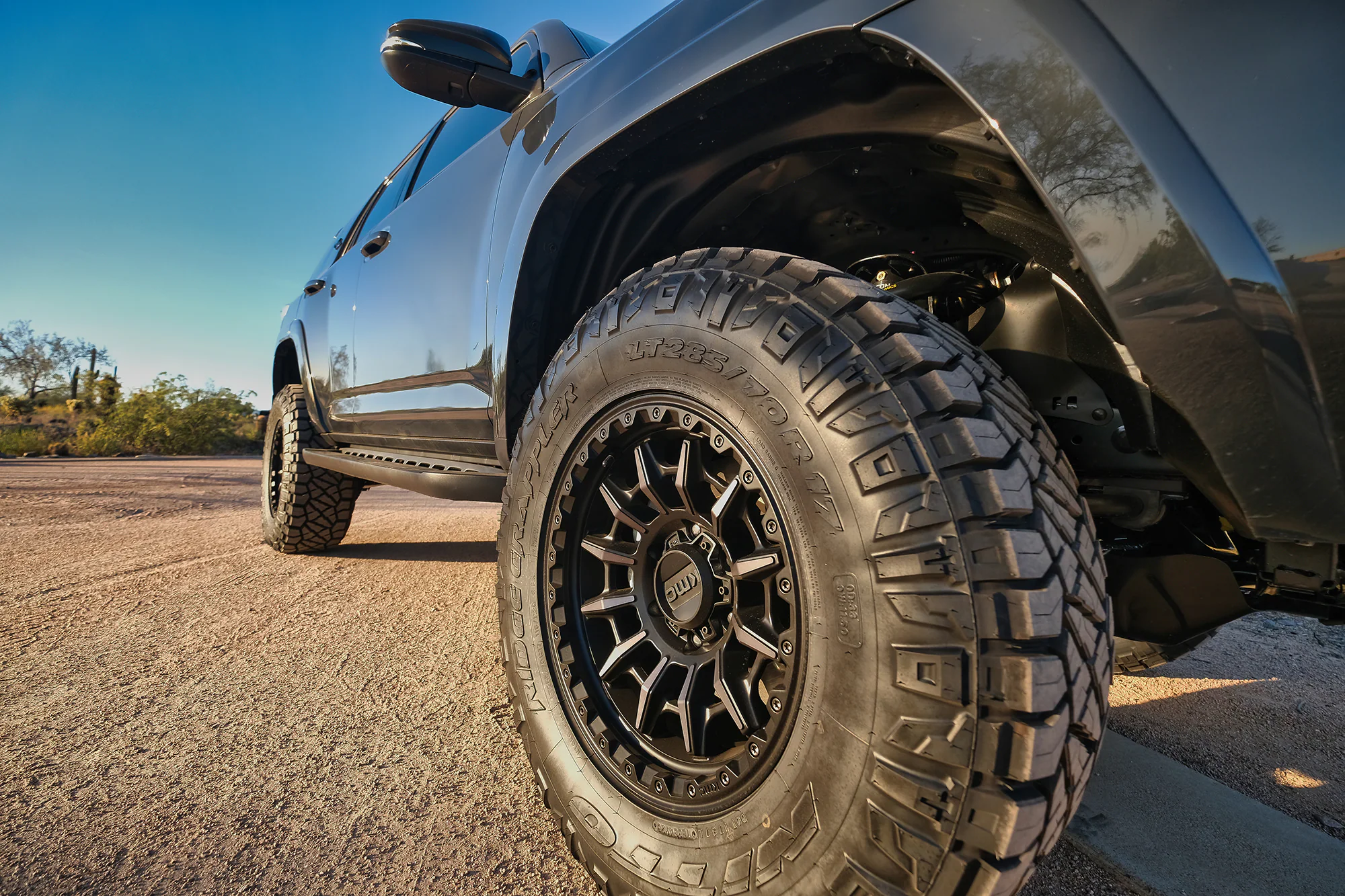
Larger tires can increase ground clearance, improve off-road capability, create a much more aggressive stance, and completely change the personality of the SUV.
But there's a point where bigger tires stop being a simple upgrade and start requiring significant supporting modifications.
That's particularly important with the Toyota 4Runner.
A 4Runner on 33-inch tires can retain excellent everyday drivability while providing serious off-road capability. Moving to 35s creates a much more aggressive build and additional clearance without necessarily turning the SUV into a dedicated trail rig.
Thirty-sevens are another story.
A 4Runner on 37s can look incredible and perform extremely well in demanding terrain, but getting there correctly requires substantially more thought.
So what's the best tire size for a Toyota 4Runner?
Let's compare 33s vs. 35s vs. 37s and determine which setup makes the most sense for your 4Runner.
What Size Tires Come on a Toyota 4Runner?
Factory tire size depends on the model year, generation, trim and equipment package.
That's especially important now that Toyota has introduced the sixth-generation 4Runner.
Certain current off-road-oriented configurations—including TRD Off-Road, Trailhunter and TRD Pro—can come equipped with approximately 33-inch all-terrain tires from the factory.
That's a substantial tire for a factory SUV.
It also gives the latest 4Runner an excellent starting point for buyers who want serious off-road capability without immediately modifying their vehicle.
But many 4Runner enthusiasts want more.
And that's where the discussion moves toward 35s and 37s.
Understanding 33s, 35s and 37s
When enthusiasts talk about 33-, 35-, or 37-inch tires, they're referring to the tire's approximate overall diameter.
You may see flotation sizes such as:
- 33x12.50
- 35x12.50
- 37x12.50
You may also encounter metric tire sizes that calculate to approximately the same diameter.
However, the number on the sidewall doesn't always represent the tire's exact mounted dimensions.
Actual diameter and width can vary depending on:
- Manufacturer
- Tire model
- Wheel width
- Inflation pressure
- Load
- Tread design
That's important when you're working with limited clearance.
Two tires advertised as 35s may not measure exactly the same.
33-Inch Tires on a Toyota 4Runner
For many 4Runner owners, 33-inch tires provide an excellent combination of capability and practicality.
That's one reason Toyota itself has chosen approximately 33-inch all-terrain tires for some of the latest 4Runner's most off-road-focused configurations.
A 33-inch setup can provide:
- Aggressive appearance
- Additional ground clearance
- Excellent off-road traction
- Reasonable weight
- Good highway manners
- Less impact on acceleration
- Less impact on braking
- Better fuel economy than larger alternatives
- Fewer fitment complications
For a 4Runner that serves as both an adventure vehicle and daily driver, that's an attractive combination.
Are 33s Big Enough for a 4Runner?
Absolutely.
Don't assume that you need 35s or 37s simply because they're available.
A properly equipped 4Runner on quality 33-inch all-terrain tires can be an extremely capable off-road SUV.
The tire also retains enough practicality for long-distance driving, commuting and road trips.
For someone who spends 80% or 90% of their time on pavement but wants legitimate capability when the pavement ends, 33s make a lot of sense.
They're also an excellent option for owners who don't want a substantial suspension lift.
Who Should Run 33s?
We'd recommend considering 33-inch tires if your 4Runner is primarily used for:
- Daily driving
- Highway commuting
- Camping
- Hunting
- Forest roads
- Moderate trails
- Snow
- Light overlanding
- Road trips
- Occasional towing
You get much of the visual and functional benefit of a larger tire without pushing the vehicle very far away from its factory driving characteristics.
35-Inch Tires on a Toyota 4Runner
For a customized 4Runner, 35-inch tires may be the sweet spot.
They're noticeably larger than 33s without moving into the more extreme territory associated with 37s.
A 4Runner on 35s immediately looks more purposeful.
The wheel wells appear fuller.
Ground clearance improves.
The stance becomes more aggressive.
And off-road, the additional tire diameter can provide meaningful advantages.
For many enthusiasts, this is the point where the 4Runner transitions from a capable factory SUV into a distinctly customized off-road build.
Advantages of 35s on a 4Runner
Compared with 33s, 35-inch tires can provide:
- More ground clearance
- Greater obstacle clearance
- More aggressive appearance
- Improved performance in deeper ruts
- Better capability over rocks and uneven terrain
- Excellent proportions with a properly lifted suspension
They're also extremely popular in the off-road aftermarket, meaning buyers have access to a wide selection of all-terrain and mud-terrain tires.
How Much More Ground Clearance Do 35s Provide?
Here's a useful way to understand tire diameter.
Going from a true 33-inch tire to a true 35-inch tire increases total diameter by approximately two inches.
Because only half of that increase is underneath the wheel centerline, theoretical ground-clearance improvement is approximately:
1 inch.
That one inch can matter.
A suspension lift raises portions of the chassis and body, but larger tires raise the wheel centerline itself.
That means they can increase clearance beneath certain low points in ways a suspension lift alone cannot.
This is why suspension height and tire diameter should be considered together.
Can You Fit 35s on a Toyota 4Runner?
Yes—but the correct answer is more complicated than simply saying "35s fit."
Fitment depends on:
- 4Runner generation
- Trim
- Suspension height
- Actual tire dimensions
- Wheel diameter
- Wheel width
- Wheel offset
- Backspacing
- Caster
- Alignment
- Fender clearance
- Body-mount clearance on applicable generations
- Suspension travel
- How the vehicle is used
A tire that clears while driving straight down the highway may still rub when the steering is at full lock.
Likewise, a setup that doesn't rub during normal street driving could make contact when the suspension compresses or articulates off-road.
Proper fitment means accounting for the entire operating range of the suspension and steering—not just whether the tire physically fits inside the wheel well.
Do You Need a Lift for 35s on a 4Runner?
In many cases, some combination of additional clearance, suspension changes, careful wheel specifications, and potentially trimming or other fitment work will be necessary.
But there is no universal lift height that guarantees 35s will fit every 4Runner.
That's because lift height isn't the only variable.
Wheel offset can completely change where the tire travels as you steer.
Tire width matters.
Actual tire diameter matters.
Suspension geometry matters.
The generation of the vehicle matters.
This is why we'd avoid choosing tires first and trying to make everything else work afterward.
The better approach is to design the:
Suspension + wheel + tire combination
as one complete system.
35s on a Sixth-Generation 4Runner
The latest 4Runner is particularly interesting because Toyota already offers approximately 33-inch tires on several off-road-oriented models.
That gives builders a stronger factory starting point.
Moving from 33s to 35s isn't as dramatic a jump as moving from a much smaller stock tire.
However, those extra inches still matter when the steering and suspension begin moving through their full ranges.
Wheel specifications become extremely important.
So does maintaining useful suspension travel.
A properly built sixth-generation 4Runner on 35s can offer an excellent balance of:
- Factory engineering
- Additional ground clearance
- Aggressive stance
- Off-road performance
- Daily drivability
For many new 4Runner owners, 35s are likely to become one of the most desirable upgrade sizes.
35s on a 4Runner TRD Off-Road
The TRD Off-Road is arguably one of the best candidates for a 35-inch build.
You already have genuine off-road equipment, including technology designed for challenging terrain.
But you're not paying primarily for the specialized suspension hardware that defines more expensive trims such as TRD Pro.
If you intend to replace or significantly modify the suspension anyway, TRD Off-Road can therefore make a lot of sense.
Combine the right suspension setup with properly selected wheels and 35-inch tires and you can build an extremely capable 4Runner without automatically starting with Toyota's most expensive off-road model.
35s on a 4Runner TRD Pro
A TRD Pro on 35s can be an outstanding combination.
But we'd approach the build somewhat differently.
Part of the value of TRD Pro is its specialized factory suspension.
On the current generation, that includes sophisticated FOX hardware and additional off-road equipment.
Simply replacing everything because you want the vehicle to sit higher can defeat part of the reason you paid for TRD Pro in the first place.
Instead, modifications should complement the factory engineering whenever possible.
The goal should be:
Make the TRD Pro better at being a TRD Pro.
Not simply taller.
35s on a 4Runner Trailhunter
The Trailhunter deserves the same consideration.
Toyota designed this model specifically around overlanding and long-distance adventure travel.
That means suspension travel, load carrying, ride quality and durability may matter more than simply achieving maximum height.
If 35s are part of the build, consider how they interact with:
- Additional camping equipment
- Roof racks
- Recovery gear
- Cargo
- Armor
- Long-distance highway driving
- Off-road articulation
The best overlanding build isn't necessarily the biggest one.
It's the one that works reliably hundreds of miles from home.
37-Inch Tires on a Toyota 4Runner
Now we're entering a different category.
Thirty-seven-inch tires are a serious modification on a 4Runner.
They create an unmistakable appearance and can significantly improve certain types of off-road capability.
But they also introduce substantially greater mechanical and fitment considerations than 33s or 35s.
This isn't simply another two-inch increase.
It's the point where the rest of the vehicle needs to be evaluated much more carefully.
Advantages of 37s on a 4Runner
Properly implemented, 37-inch tires can provide:
- Maximum ground clearance of these three sizes
- Greater obstacle clearance
- Improved capability in deep terrain
- More tire footprint depending on setup
- More aggressive appearance
- Serious rock-crawling potential
- Exceptional visual presence
For a dedicated off-road build, those advantages can be worthwhile.
For the average daily driver?
Maybe not.
How Much Ground Clearance Do 37s Add?
Moving from a true 33-inch tire to a true 37-inch tire increases overall diameter by approximately four inches.
The theoretical increase in clearance at the wheel centerline is therefore approximately:
2 inches.
Compared with 35s, moving to 37s adds approximately another:
1 inch.
That's meaningful off-road.
But you're paying for that additional clearance in other areas.
What Changes When You Put 37s on a 4Runner?
Almost everything becomes more important.
Thirty-seven-inch tires are generally heavier.
They create greater rotational inertia.
They alter effective gearing.
They can affect:
- Acceleration
- Braking
- Steering
- Fuel economy
- Transmission behavior
- Drivetrain loads
- Wheel bearings
- Suspension components
- Clearance
- Turning radius
- Ride quality
- Highway behavior
A 37-inch tire also requires considerably more physical space as it moves through the steering and suspension range.
That's why simply adding more lift isn't always the correct solution.
How Much Lift Do You Need for 37s?
There's no responsible universal answer.
The amount of lift required depends on the specific 4Runner, suspension design, wheel specifications, tire dimensions and intended use.
More importantly, increasing suspension height indefinitely isn't necessarily desirable.
Excessive lift can negatively affect suspension geometry, CV angles, steering characteristics and stability.
Proper 37-inch fitment may involve a combination of:
- Suspension changes
- Correct wheel offset
- Clearance modifications
- Trimming
- Alignment adjustments
- Bump-stop considerations
- Potential drivetrain modifications
- Potential gearing changes
The correct build focuses on usable clearance, not simply lift height.
33s vs. 35s on a Toyota 4Runner
For most buyers, this is the comparison that matters.
Choose 33s if:
- Your 4Runner is a daily driver.
- You travel substantial highway miles.
- You want excellent off-road capability without major modifications.
- Fuel economy matters.
- You want to preserve near-factory driving characteristics.
- You don't need maximum stance.
- You want lower tire replacement costs.
Choose 35s if:
- You want a noticeably more aggressive 4Runner.
- You're willing to modify the suspension.
- You want additional ground clearance.
- You spend more time off-road.
- You want better obstacle clearance.
- You want the classic customized 4Runner stance.
- You accept some reduction in fuel economy and performance.
For many Lifted Trucks customers, we'd choose:
35s.
They provide a significant visual and functional upgrade without necessarily creating the complexity associated with 37s.
35s vs. 37s on a Toyota 4Runner
This decision should be based much more heavily on intended use.
35s offer:
- Easier fitment
- Lower weight
- Better acceleration
- Better braking
- Better fuel economy
- Less drivetrain stress
- More reasonable modification requirements
- Excellent ground clearance
- Strong off-road capability
- Better daily drivability
37s offer:
- Additional ground clearance
- Greater obstacle clearance
- Maximum visual impact
- More serious rock-crawling potential
- Better capability in certain extreme terrain
But that capability comes with additional cost and complexity.
For a multi-purpose 4Runner that sees both highway and trail use, 35s are generally the more balanced choice.
For a specialized off-road build where maximum clearance is genuinely useful, 37s may be worth it.
How Tire Size Affects Effective Gearing
Larger tires effectively make the vehicle's gearing taller.
Think about the tire as a lever.
As the tire gets larger, the drivetrain has to turn a longer lever to move the vehicle.
That can reduce the mechanical advantage delivered by the axle gearing.
The result may include:
- Slower acceleration
- More frequent transmission shifting
- Reduced responsiveness
- Changes in low-speed crawling behavior
- Greater load while towing
Going from 33s to 35s creates a relatively modest change.
Moving from 33s to 37s creates a substantially larger one.
Do You Need to Regear a 4Runner for 35s?
Not automatically.
Whether regearing makes sense depends on:
- Generation
- Powertrain
- Factory axle ratio
- Actual tire diameter
- Tire weight
- Wheel weight
- Vehicle weight
- Elevation
- Driving style
- Off-road use
- Towing
A modern 4Runner may be perfectly acceptable to its owner on 35s with factory gearing.
Someone else may want different gearing to restore more of the original acceleration and crawl characteristics.
Evaluate the entire vehicle rather than assuming every 35-inch setup requires the same solution.
Do You Need to Regear for 37s?
With 37s, gearing becomes a much more important consideration.
The additional diameter and rotating mass can make the change in effective gearing considerably more noticeable.
For a serious off-road build, restoring appropriate gearing can improve:
- Low-speed control
- Acceleration
- Transmission behavior
- Engine operating range
- Overall drivability
But again, the correct ratio depends on the specific vehicle and powertrain.
There isn't one universal "37-inch tire gear ratio" for every 4Runner.
i-FORCE MAX and Larger Tires
The sixth-generation 4Runner's available i-FORCE MAX powertrain makes this discussion particularly interesting.
It produces up to:
326 net combined horsepower
and
465 lb-ft of torque.
That torque can be especially valuable with larger tires.
Additional low-rpm torque helps the vehicle overcome some of the additional load associated with a heavier wheel-and-tire package.
It can also be valuable when:
- Climbing
- Crawling
- Towing
- Driving at elevation
- Carrying overlanding equipment
That doesn't make tire weight irrelevant.
Physics still wins.
But the i-FORCE MAX powertrain gives the new 4Runner an excellent foundation for larger-tire builds.
Wheel Weight Matters
Enthusiasts often focus exclusively on tire diameter.
That's a mistake.
Consider two 4Runners.
Both run 35-inch tires.
One has a relatively lightweight wheel-and-tire package.
The other uses extremely heavy wheels and heavy-duty mud-terrain tires.
Those vehicles may behave very differently.
Additional rotating mass can affect:
- Acceleration
- Braking
- Steering response
- Fuel economy
- Suspension behavior
- Ride quality
The goal shouldn't simply be finding a 35-inch tire.
It should be finding the right 35-inch tire and wheel combination.
Wheel Offset Matters Just as Much as Tire Diameter
This is one of the most important concepts when fitting larger tires.
Wheel offset changes where the tire sits relative to:
- Suspension components
- Steering components
- Fenders
- Bodywork
- Inner liners
Moving the wheel outward may create additional clearance in one area while reducing it somewhere else.
It can also change scrub radius and steering characteristics.
This is why copying another 4Runner's tire size without knowing its wheel specifications can produce completely different results.
Tire diameter is only one part of fitment.
17s vs. 18s vs. 20s on a 4Runner
Wheel diameter changes the character of the build.
For a given tire diameter, a smaller wheel generally leaves more sidewall.
More sidewall can provide benefits off-road, including additional compliance and greater ability to air down.
Larger wheels create a different aesthetic and may appeal more to owners prioritizing street presence.
For an off-road-focused 4Runner, we'd generally favor maintaining meaningful sidewall rather than maximizing wheel diameter.
For a street-oriented custom build, appearance may carry more weight in the decision.
Again:
Build for the way you actually use the vehicle.
How Larger Tires Affect Fuel Economy
Expect larger tires to influence fuel economy.
The exact change varies considerably because diameter isn't the only factor.
Larger tires may be:
- Heavier
- Wider
- More aggressive
- Higher in rolling resistance
Combine that with a suspension lift and the vehicle may also experience additional aerodynamic drag.
A lightweight 35-inch all-terrain tire on a carefully selected wheel may have a very different effect from a heavy 35-inch mud terrain.
Moving to 37s generally magnifies these considerations.
How Larger Tires Affect Braking
Acceleration gets most of the attention, but braking matters just as much.
A heavier wheel-and-tire package has more rotational energy.
Your brakes have to control that additional mass.
For a modest tire-size increase, the difference may not dramatically change normal driving.
As wheel and tire size and weight increase, braking performance deserves more attention.
This becomes particularly important if the vehicle also carries:
- Steel bumpers
- Winches
- Armor
- Roof racks
- Camping equipment
- Additional fuel
- Recovery gear
- Other overlanding equipment
Build weight accumulates quickly.
How Larger Tires Affect Off-Road Capability
Larger tires can provide real advantages.
They can increase ground clearance.
They can improve obstacle clearance.
Depending on the tire and terrain, they may provide a larger usable footprint.
But don't assume that the 4Runner with the largest tires is automatically the most capable.
A properly built 4Runner on 33s with excellent suspension articulation, appropriate gearing, lockers and a skilled driver may outperform a poorly designed vehicle on 37s.
Off-road capability is a system.
Tires are one component of that system.
What Tire Size Is Best for Overlanding?
For most overlanding builds, we'd favor 33s or 35s.
Why?
Because overlanding frequently involves traveling long distances before you ever reach the trail.
- Reliability matters.
- Fuel range matters.
- Highway comfort matters.
- Replacement-tire availability matters.
- Vehicle weight matters.
- Airing down and sidewall performance matter.
Thirty-sevens can certainly work on an overlanding build, but ask whether the additional clearance is genuinely worth the additional weight and complexity.
For many travelers, a quality 33- or 35-inch all-terrain tire is the better solution.
What Tire Size Is Best for Daily Driving?
33s win if daily drivability is the primary objective.
They provide a rugged appearance and legitimate capability while retaining more of the vehicle's original characteristics.
That doesn't mean 35s make a bad daily driver.
A properly engineered 4Runner on 35s can still be extremely comfortable and practical.
But if we rank the three strictly for everyday use:
- 1. 33s
- 2. 35s
- 3. 37s
As tire diameter increases, compromises generally increase with it.
What Tire Size Looks Best on a 4Runner?
This is subjective, but proportions matter.
- 33s look rugged and purposeful.
- 35s create the classic modified 4Runner appearance.
- 37s create maximum visual impact.
Suspension height changes the equation.
A tall suspension lift on 33s may make the tires look undersized.
Thirty-sevens without appropriate suspension and body clearance may look stuffed into the wheel wells.
A well-proportioned build should look intentional.
The best-looking 4Runners aren't necessarily the tallest.
They're the ones where suspension height, wheel specifications and tire diameter work together.
What's the Best Tire Size for a Toyota 4Runner?
For the majority of owners:
- 33s are the best choice for mostly stock vehicles.
- 35s are the best choice for most modified vehicles.
- 37s are best reserved for more specialized builds.
If we were building a 4Runner that needed to commute Monday through Friday, drive across the country, carry the family and still tackle serious trails on the weekend, we'd strongly consider 35-inch tires.
They offer an excellent combination of:
- Appearance
- Ground clearance
- Capability
- Aftermarket availability
- Daily drivability
- Manageable modification requirements
That's why 35s have become such a popular size throughout the off-road community.
33s vs. 35s vs. 37s: The Bottom Line
There isn't one correct tire size for every Toyota 4Runner.
The right answer depends on what you expect the vehicle to do.
Choose 33s if you want excellent capability with minimal compromise.
Choose 35s if you want the best balance of custom appearance, additional clearance and everyday usability.
Choose 37s if you're building a more specialized off-road vehicle and are prepared to address the additional fitment, gearing, braking, suspension and drivetrain considerations.
Most importantly, don't choose tire diameter in isolation.
The best builds treat:
- Suspension
- Wheels
- Tires
- Alignment
- Clearance
- Powertrain
- Intended use
as parts of one complete system.
That's how you build a 4Runner that doesn't just look capable.
It actually works.
Find a Lifted Toyota 4Runner on 33s, 35s or 37s at Lifted Trucks
At Lifted Trucks, we've spent decades building custom vehicles, and choosing the right wheel-and-tire combination is a fundamental part of creating a properly executed build.
Our inventory can include Toyota 4Runners equipped with professionally selected suspension systems, wheels, all-terrain tires, mud-terrain tires and other upgrades designed to create the right combination of stance, capability and drivability.
Whether you're looking for a clean daily-driven 4Runner, a TRD Off-Road on 35s, a customized TRD Pro, an adventure-ready Trailhunter or a more aggressive off-road build, our team can help you find the right vehicle.
And you don't have to limit your search to your local market.
Lifted Trucks serves customers across the country, with nationwide shipping to help get the custom Toyota 4Runner you want closer to home.
Explore our current selection of custom Toyota 4Runners and find the tire and suspension setup that's right for your next adventure.