Lifted F-250 vs F-350: Which Should You Buy for Hauling Equipment?
7 min de lectura
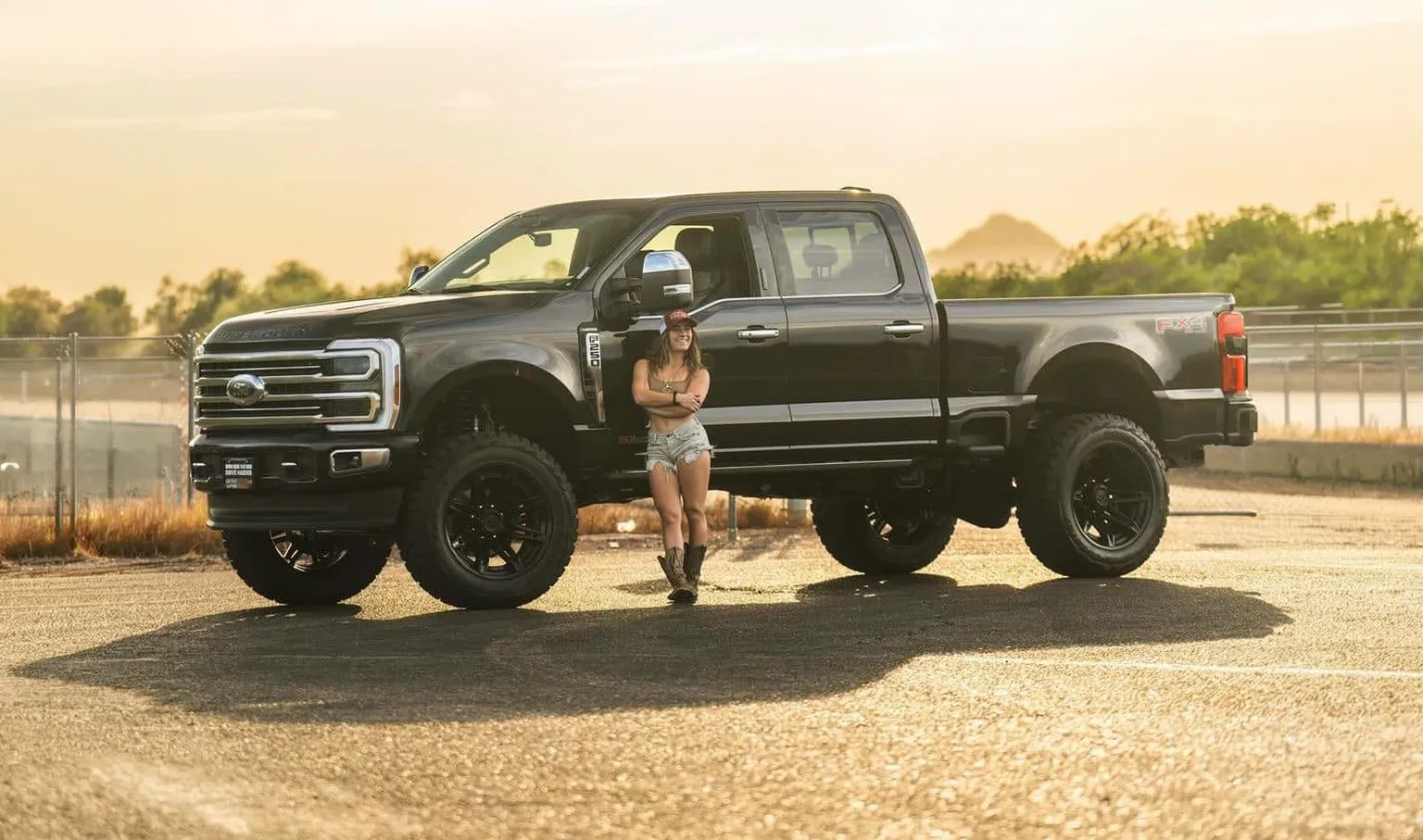
If you haul equipment for a living or for a ranch, the short answer is this: buy the F-250 when your heaviest trailer and its tongue weight sit comfortably inside a single-rear-wheel truck's ratings, and buy the F-350 when you want a larger safety margin, a dually option, or a gooseneck or fifth-wheel setup that you will load to the limit every week. Lifting either truck is entirely practical, but the lift changes how you should think about stability, tire choice and axle loading, which is why the right build matters as much as the right badge.
En este artículo
At Lifted Trucks, we build and sell Super Duty trucks for owners who tow and haul in the real world, so this guide walks through the numbers Ford publishes, what they mean for a skid steer, mini excavator, backhoe or tractor, and how a lift changes the decision.
Quick Answer: F-250 or F-350 for Hauling Equipment?
For most buyers hauling a compact track loader, skid steer or mini excavator on a tandem-axle trailer, a properly equipped F-250 diesel is often enough, and it rides and drives more like a daily driver. For buyers who regularly run near the top of the weight range, pull gooseneck or fifth-wheel trailers, carry a heavy slide-in or flatbed, or want maximum stability, the F-350 (especially as a dually) is the safer long-term choice. The deciding factors are payload, tongue weight, hitch type and how close to the limit you work, not the bragging rights of the bigger number.
What Ford Publishes for the 2026 Super Duty
Ford's own figures set the ceiling for the whole Super Duty family. According to Ford, the 2026 Super Duty offers a maximum available gooseneck towing rating of 40,000 pounds, a maximum available fifth-wheel rating of 35,000 pounds, and a maximum available conventional towing rating of 30,000 pounds. Maximum available payload is listed at 8,000 pounds with the 6.8L gas V8 and 6,952 pounds with the 6.7L Power Stroke diesel, while the 6.7L High Output diesel is listed at 6,935 pounds. The High Output diesel makes 500 horsepower and 1,200 lb-ft of torque, and the standard Power Stroke makes 475 horsepower and 1,050 lb-ft.
Two cautions matter here. First, these are maximums for specific, properly equipped configurations, and Ford notes that the 40,000-pound gooseneck figure requires the 40K Gooseneck Tow Package and the 8,000-pound payload figure requires specific packages. Second, they describe the Super Duty line as a whole, not the F-250 alone. Always read the numbers for the exact truck you are considering and the Safety Compliance Certification Label on the driver's door jamb. Source: Ford 2026 Super Duty pickup towing information and Ford Super Duty overview.
How Much Can a Single-Rear-Wheel F-250 Tow?
Ford's towing guide gives specific ratings for the 2026 F-250 SRW. With the 6.7L Power Stroke diesel and the F-250 High-Capacity Axle Upgrade Package, conventional towing ratings in the guide reach about 18,200 to 22,000 pounds depending on cab, bed length and drive type, with the highest figures appearing on crew cab configurations. For fifth-wheel and gooseneck towing, the same guide lists ratings in the low 20,000-pound range, topping out near 23,000 pounds on the High Output diesel in some configurations. Gas V8 ratings are lower, with the 6.8L in the mid-teens and the 7.3L reaching roughly 18,200 pounds conventionally in the guide.
In plain terms, a well-optioned F-250 diesel can handle a tandem-axle equipment trailer carrying a skid steer or a compact excavator. A typical trailer of that type loaded with a machine commonly lands well under the F-250's conventional ratings, but the real limit is often payload rather than towing capacity.
Where the F-350 Pulls Ahead
The F-350 shares its engines and platform with the F-250, but it is built to carry and tow more, especially in dual-rear-wheel form. Ford describes dual rear wheels as ideal for heavy-duty towing and hauling because of greater stability, higher towing and payload capacity, and improved weight distribution, while single rear wheels suit light to moderate towing and everyday driving with better maneuverability. For equipment haulers, that stability is the real benefit. A dually puts two tires on each side of the rear axle, which reduces trailer sway sensitivity and gives gooseneck and fifth-wheel loads a firmer platform.
Exact F-350 SRW and DRW payload, GVWR and towing numbers vary widely by cab, bed, engine and axle. Ford also publishes a Trailer Towing Selector and a Safe Towing Capacity tool that let a buyer confirm a specific truck.
Payload Is the Number Equipment Haulers Overlook
Many first-time equipment buyers shop by the maximum towing number, then discover that payload limits them first. A heavy trailer puts tongue weight on the hitch, which Ford says should be about 10 percent of the loaded trailer weight for conventional towing and 15 percent for fifth-wheel and gooseneck towing. That weight, plus passengers, a toolbox, fuel and accessories, all count against the truck's payload. A 20,000-pound gooseneck trailer, for example, places roughly 3,000 pounds on the truck before anyone climbs in.
This is where the F-350 often earns its place. A higher-payload configuration gives you headroom for pin weight, a bed-mounted hitch, a hay or tool bed, and a full crew. The F-250 can work well when your trailer is lighter and your tongue weight stays modest. If you plan to add a heavy aftermarket bumper, winch, steel bed accessories or oversize wheels and tires, subtract those pounds from payload before you decide.
Gooseneck, Fifth-Wheel or Bumper Pull?
Hitch style shapes the decision as much as the truck. Bumper-pull trailers suit smaller equipment and shorter hauls. Gooseneck and fifth-wheel trailers put the load over the rear axle, which improves stability and lets the truck carry heavier trailers, but they raise the payload bar considerably. Ford's guide also lists tailgate heights for gooseneck and fifth-wheel towing, roughly 58 to 60 inches for the F-250 SRW and F-350 SRW and about 58.6 to 60.3 inches for the F-350 DRW in the guide's 4x4 figures. Tailgate height matters more once you lift, because a taller truck changes trailer level and clearance. Always measure your trailer's kingpin height against your lifted truck before you buy.
How a Lift Changes Hauling
A lift is not a deal breaker for hauling, but it is a trade. Lifting raises the center of gravity, can change trailer angle, and can alter braking and steering feel, especially with larger tires. That is why our approach at Lifted Trucks favors balanced builds over extreme height. A moderate lift with quality components and properly sized tires keeps highway stability, towing behavior and daily drivability intact, while an extreme stance with oversize tires can reduce them. For a working truck, we generally recommend keeping the lift modest, choosing tires with an appropriate load range, and confirming that wheels, tires and suspension do not reduce the usable rating of the truck. Taller tires also change speedometer calibration, gearing feel and sometimes effective towing performance.
Lift height also changes the hitch conversation. A raised truck pulling a low equipment trailer can leave the trailer nose-down unless you use a drop hitch or raise the trailer, and either fix has to be rated for your tongue weight. Because aftermarket parts and warranty terms vary by installer and brand, confirm current modification-warranty coverage in writing before you buy.
Gas or Diesel for Equipment Hauling?
Diesel is the usual choice for heavy equipment. The 6.7L Power Stroke's 1,050 lb-ft of torque (1,200 lb-ft on the High Output) holds speed on grades under load and gives the highest towing ratings in Ford's guide. The 7.3L gas V8, at 485 lb-ft, is a simpler and lower-cost choice for lighter trailers and shorter hauls, and Ford lists its conventional rating up to roughly 22,500 pounds as a maximum with the right equipment. The 6.8L gas V8 suits occasional light towing. Buyers who tow every week usually see the diesel's torque and exhaust brake benefits pay off quickly.
Which Should You Buy? A Practical Decision Guide
Choose a lifted F-250 if your equipment trailer and machine together stay comfortably below the truck's rated limits, your tongue weight leaves plenty of payload, you drive the truck daily, and you value a smoother ride and easier parking. Choose a lifted F-350 if you pull gooseneck or fifth-wheel trailers, run near the limit, carry heavy bed accessories, haul with a full crew, or want dually stability for long highway hours. Choose a dually if stability and the highest ratings are the priority and you accept a wider truck that is harder to park and fit in some garages.
A useful rule is to take the loaded weight of your heaviest trailer, calculate tongue or pin weight, add passengers and gear, and then ask whether the truck still has margin. If the answer is only just, step up to the next truck. Margin protects your brakes, tires and drivetrain over years of ownership, which is the way we design every build.
Frequently Asked Questions
Is the F-350 better than the F-250 for towing equipment? In general the F-350 offers higher capability, particularly as a dually, but the best choice depends on your trailer weight, hitch type and payload needs.
Can I lift an F-350 dually? Lift options for dually trucks are more limited than for single rear wheel trucks, and wheel and tire choices differ. Confirm fitment for your exact truck with your builder before you buy.
Does lifting reduce towing capacity? A lift does not change the manufacturer's rated capacity on paper, but larger tires, added weight and a changed center of gravity can affect real-world towing behavior and payload, so keep the build balanced.
What weight can an F-250 haul on a skid steer trailer? Many F-250 diesels handle typical skid steer trailers, but confirm your combined trailer and machine weight against the door-jamb label and Ford's towing guide.
Ready to Find the Right Super Duty?
Whether you need a lifted F-250 that works hard and drives easy or an F-350 built for heavy equipment, our team can help you match a truck to your trailer and your workload. Explore our lifted Ford Super Duty inventory today, and take advantage of nationwide shipping to get your next truck delivered to your door.