Half-Ton vs. HD Trucks for Powersports: How Much Truck Do You Really Need?
12 min de lectura
You've got the toys.
En este artículo
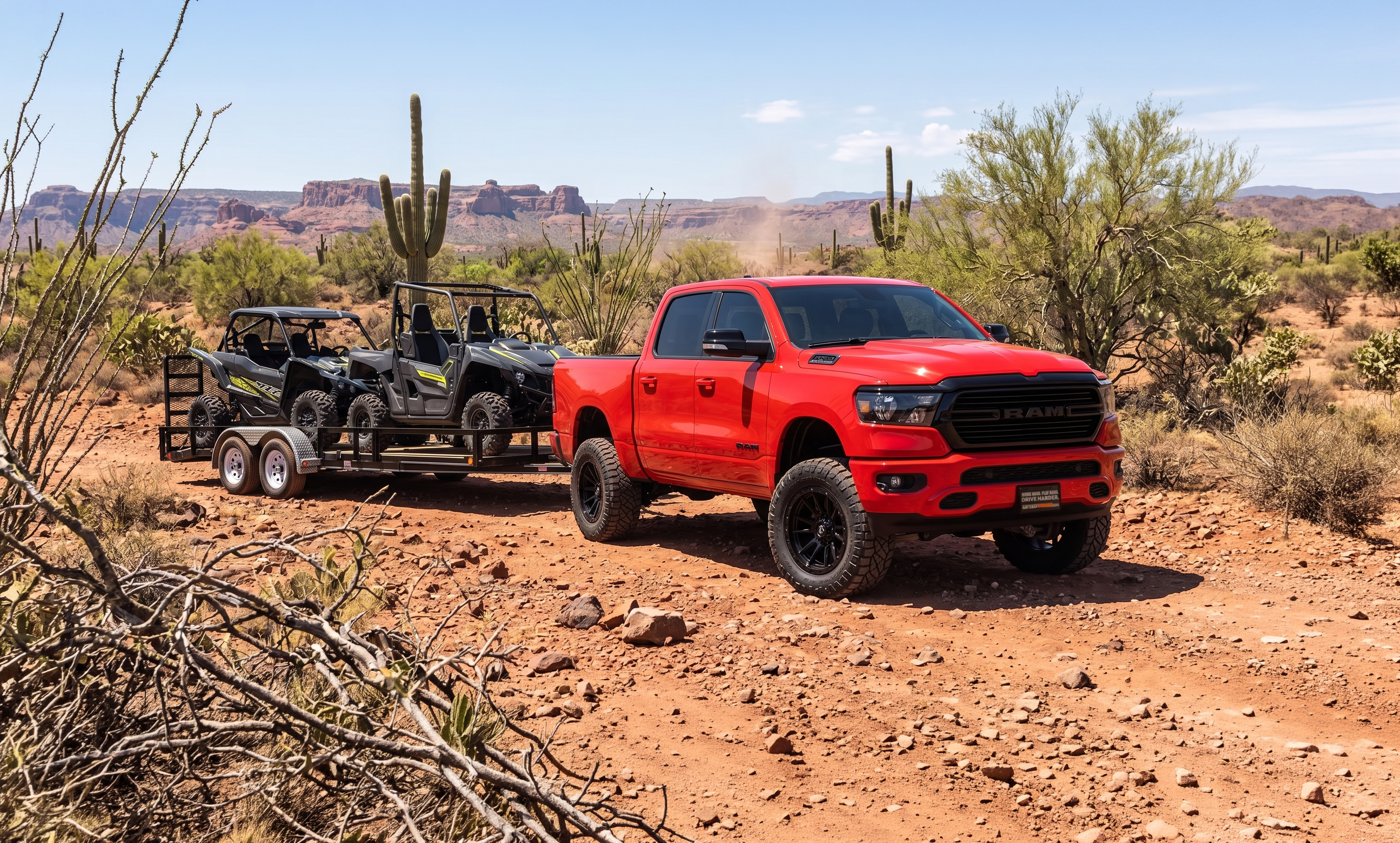
Now how much truck do you actually need to move them?
For powersports enthusiasts, that question can get complicated surprisingly quickly.
One dirt bike in the bed is easy. Two ATVs on a lightweight trailer aren't particularly intimidating either.
But then you buy a side-by-side.
Then a bigger trailer.
Then another machine.
Add tools, fuel, spare tires, camping equipment, coolers and four people—and suddenly that half-ton pickup is doing a very different job.
Does that mean every serious powersports enthusiast needs an F-250, Silverado 2500HD, Sierra 2500HD or Ram 2500?
Absolutely not.
Modern half-ton trucks are remarkably capable, and for many dirt bike, ATV and UTV owners, they're exactly the right tool.
The trick is knowing when your powersports lifestyle has crossed the line where a heavy-duty truck starts making more sense.
Here's how to figure it out.
What Do We Mean by Half-Ton and Heavy Duty?
"Half-ton" is an old truck classification that no longer literally describes how much weight these trucks can carry.
Today, the mainstream full-size half-ton category includes trucks such as:
-
Ford F-150
-
Chevrolet Silverado 1500
-
GMC Sierra 1500
-
Ram 1500
-
Toyota Tundra
Move into the heavy-duty category and you encounter trucks such as:
-
Ford F-250 and F-350 Super Duty
-
Chevrolet Silverado 2500HD and 3500HD
-
GMC Sierra 2500HD and 3500HD
-
Ram 2500 and 3500
The important distinction isn't the badge.
HD trucks are engineered around more demanding workloads.
Depending on configuration, that can mean greater payload and towing capability along with heavier-duty frames, axles, suspension components, cooling systems, brakes and powertrains.
But capability comes with trade-offs.
HD trucks are generally larger, heavier and more expensive than their half-ton counterparts.
So the goal isn't to buy the biggest truck possible.
It's to buy enough truck for what you actually do.
Start With Your Powersports Setup
Before comparing trucks, inventory what you're transporting.
Maybe it's:
-
One or two dirt bikes
-
A motocross race setup
-
One ATV
-
Multiple quads
-
A two-seat UTV
-
A four-seat side-by-side
-
Multiple UTVs
-
Snowmobiles
-
A combination of machines
Then think beyond the vehicles themselves.
You're probably also transporting fuel, helmets, riding gear, tools, spare parts, recovery equipment, coolers, water and potentially camping equipment.
And, of course, people.
Your truck doesn't care whether the weight comes from a $30,000 side-by-side or a toolbox.
Weight is weight.
Scenario 1: One or Two Dirt Bikes
This is firmly in half-ton territory for most riders—and you may not even need a full-size truck.
Dirt bikes are relatively lightweight compared with the payload capabilities of modern pickups.
A rider carrying one bike in the bed could potentially be perfectly happy with a midsize truck such as a Tacoma, Ranger, Colorado or Canyon.
Move into a full-size F-150, Silverado 1500, Sierra 1500, Ram 1500 or Tundra and you gain additional bed, cabin and towing capacity.
An HD truck can obviously carry dirt bikes.
But if that's your only requirement, you're buying far more truck than the motorcycles themselves demand.
The calculation changes if those bikes live inside a large enclosed race trailer.
More on that shortly.
Scenario 2: ATVs and Quads
ATVs occupy an interesting middle ground.
Depending on dimensions and configuration, some can be transported directly in a pickup bed.
Others are better suited to trailers.
Transport multiple quads and a trailer quickly becomes the obvious solution.
For many recreational ATV owners, a properly configured half-ton provides more than enough truck.
A relatively lightweight open trailer carrying one or two machines doesn't automatically justify stepping into an HD platform.
But once again, the toys aren't the entire equation.
Add a larger trailer, several machines and enough equipment for a family weekend and the total load begins growing.
Scenario 3: One UTV or Side-by-Side
This is where truck selection starts becoming more interesting.
Modern side-by-sides can be substantial machines.
A Polaris RZR, Can-Am Maverick, Honda Talon, Kawasaki Teryx KRX or similar UTV plus a properly sized open trailer can still fall comfortably within the capabilities of many properly equipped half-ton trucks.
For a recreational owner towing one UTV several hours to a trail system, a half-ton may actually be preferable to an HD truck.
You get useful towing capability while retaining everyday comfort, maneuverability and easier parking.
This is one of the strongest use cases for the modern half-ton.
Scenario 4: A Four-Seat UTV With Lots of Gear
Now pay closer attention.
Four-seat side-by-sides are longer and can be heavier than smaller machines.
Then enthusiasts start modifying them.
Larger wheels and tires.
Spare tire carriers.
Winches.
Skid plates.
Bumpers.
Doors.
Audio systems.
Storage.
Tools.
Recovery equipment.
The machine that left the dealership isn't necessarily the machine you're towing two years later.
A properly configured half-ton may still be completely appropriate.
But this is where we'd stop looking only at the UTV's factory weight and start calculating the complete loaded trailer.
Scenario 5: Multiple UTVs
Two side-by-sides change the conversation significantly.
Now you need a trailer large enough to carry both machines.
That trailer weighs more.
The machines weigh more.
You're probably carrying more equipment.
And there's a good chance you're traveling with more people.
This is where HD trucks become increasingly attractive.
An F-250, Silverado 2500HD, Sierra 2500HD or Ram 2500 provides a platform designed around heavier towing and payload demands.
Could a properly configured half-ton handle some multi-UTV combinations?
Potentially.
But the question shouldn't be:
"Can I technically tow this?"
A better question is:
"Which truck is appropriately matched to this workload?"
That's an important distinction.
Open Trailers Favor Half-Tons
Trailer design makes a major difference.
An open powersports trailer is generally relatively light and presents less frontal area to the wind.
For a single dirt bike, ATV or UTV—or even some multi-machine setups—that can keep total trailer weight relatively modest.
This is where half-tons shine.
You get enough truck to handle the recreational workload without living with an HD pickup every day.
If your powersports lifestyle revolves around relatively lightweight open trailers, don't assume you need heavy duty.
Run the numbers first.
Enclosed Trailers Push the Equation Toward HD
Enclosed trailers are different.
They're fantastic for powersports.
Your machines are protected from weather and road debris.
Tools stay organized.
You can build cabinets and workbenches.
Expensive equipment can remain out of sight.
The trailer can become a changing area, mobile garage or even a basic camping setup.
But enclosed trailers add weight.
They also add something that doesn't show up on a scale:
Aerodynamic drag.
Pulling a tall enclosed trailer down the interstate means pushing a large wall through the air.
That can make an enclosed trailer feel substantially more demanding than an open trailer of similar weight.
The larger the enclosed trailer becomes, the more attractive an HD tow vehicle starts to look.
Payload: The Number Powersports Owners Forget
Maximum towing capacity gets all the attention.
Payload frequently determines whether your truck is actually appropriate for the job.
Payload is the amount of weight the truck itself can carry.
That includes:
-
Passengers.
-
Cargo.
-
Tools.
-
Fuel containers.
-
Equipment in the bed.
-
And importantly, the trailer's tongue weight.
Let's say your truck has enough advertised towing capacity for your trailer.
Great.
Now put four adults in the cab.
Fill the bed with coolers, tools, recovery equipment and camping gear.
Then connect the trailer and transfer its tongue weight onto the truck.
All of that consumes payload.
This is one reason HD trucks become so useful for serious powersports enthusiasts.
They can provide substantially greater payload capacity depending on configuration.
Don't Shop by Maximum Tow Rating Alone
A manufacturer might advertise an enormous maximum towing number.
That doesn't mean every truck carrying that badge can tow that amount.
Actual ratings vary with:
-
Engine.
-
Transmission.
-
Axle ratio.
-
Cab configuration.
-
Bed length.
-
Drivetrain.
-
Trim.
-
Optional equipment.
-
Payload.
-
Hitch configuration.
A heavily optioned crew-cab truck may have different ratings from a more basic version of the same model.
Always check the ratings for the specific truck you're considering.
The sticker and specifications for the actual vehicle matter more than the number in an advertisement.
Half-Ton Advantage: Everyday Driving
Here's where half-tons fight back.
Most powersports enthusiasts don't tow every day.
Your UTV might come out twice a month.
Your dirt bikes might travel every weekend during riding season.
But Monday morning still happens.
You commute.
Go to the store.
Pick up the kids.
Park at restaurants.
Navigate parking garages.
Drive through town.
A half-ton generally makes those everyday tasks easier than a larger HD truck.
That's why buying more truck than you need isn't automatically an upgrade.
If an F-150, Silverado 1500, Sierra 1500, Ram 1500 or Tundra comfortably handles your loaded setup, staying with the half-ton platform can make excellent sense.
HD Advantage: Capacity and Confidence
The argument for HD isn't simply that it can pull more.
It's that the entire truck is designed around heavier work.
When you're towing a large enclosed trailer across several states, that becomes valuable.
Greater available payload can accommodate people and equipment more easily.
Heavy-duty suspension and chassis components are designed for demanding loads.
Larger available powertrains can make substantial trailers easier to move.
And the truck provides room for your powersports hobby to grow.
Maybe today you own one UTV.
What happens when you buy another?
That's worth considering before purchasing the tow vehicle.
Gas or Diesel HD?
Stepping into an HD truck creates another decision.
Gas or diesel?
For many powersports enthusiasts, a modern gas HD truck is more than enough.
Gas can make particular sense if you tow moderate distances, don't tow constantly and want to avoid the higher initial cost and additional diesel-specific systems.
Diesel becomes increasingly attractive as trailer weight, towing frequency, mileage and terrain increase.
Modern heavy-duty diesels produce enormous low-rpm torque and are particularly well suited to sustained heavy towing.
Exhaust braking can also be extremely useful when towing substantial trailers through mountainous terrain.
Someone towing one UTV locally probably doesn't need diesel.
Someone pulling a large enclosed multi-UTV trailer through Colorado several times a year may view the equation very differently.
What About a One-Ton?
There's another step beyond 3/4-ton HD trucks.
-
F-350.
-
Silverado 3500HD.
-
Sierra 3500HD.
-
Ram 3500.
For the majority of recreational powersports owners, a one-ton isn't necessary.
But start talking about very large enclosed trailers, multiple machines, toy-hauler-style configurations or substantial tongue and pin weights and the additional capability can become relevant.
Single-rear-wheel configurations can provide significant capability without going all the way to a dually.
For the heaviest recreational setups, dual-rear-wheel trucks offer another level of rear-axle and payload capability depending on configuration.
Again, don't buy one because it looks impressive on paper.
Buy it because the workload justifies it.
Does a Lifted Truck Change the Equation?
It can.
A properly built lifted truck can make an outstanding powersports tow vehicle, particularly because powersports destinations often involve rough roads, desert terrain, sand, mud and remote staging areas.
But modifications need to respect the truck's job.
Lifting the truck changes hitch height.
That may require a properly rated drop hitch to keep the trailer at the appropriate attitude.
Larger tires can change effective gearing and vehicle behavior.
Aftermarket wheels and tires need appropriate load ratings.
Suspension modifications should be selected with the truck's towing and payload requirements in mind.
The best lifted powersports truck isn't simply tall.
It's built as a complete system.
Off-Road Access Matters
This is an area where spec-sheet comparisons can miss the point entirely.
Your trailer might spend most of its journey on pavement.
The final five miles may be another story.
Powersports staging areas can involve:
-
Dirt roads.
-
Sand.
-
Snow.
-
Mud.
-
Ruts.
-
Washboards.
-
Rocky access roads.
-
Uneven parking areas.
That's where four-wheel drive, ground clearance, appropriate tires and recovery points can become extremely useful.
Your tow vehicle doesn't need to follow the UTV down every trail.
It does need to reach the place where the trail begins.
Think of the Truck as Base Camp
The best powersports trucks do much more than tow.
Once you reach the riding area, the truck becomes headquarters.
It's where you keep water.
Tools.
First-aid equipment.
Recovery gear.
Food.
Extra clothing.
Communications equipment.
Chargers.
Spare parts.
Air compressors.
Fire extinguishers.
Maybe even camping equipment.
This is why bed space and cab configuration deserve consideration alongside horsepower and towing capacity.
A crew-cab truck with a well-organized bed can function as a surprisingly capable mobile base camp.
When a Half-Ton Is Probably Enough
A half-ton deserves serious consideration if you primarily transport:
-
One or two dirt bikes.
-
One or two ATVs.
-
A single UTV on a relatively lightweight trailer.
-
A modest open powersports trailer.
-
Or a smaller enclosed trailer that remains comfortably within the specific truck's ratings.
It's also especially attractive if the truck spends considerably more time commuting than towing.
For many enthusiasts, half-ton is the sweet spot.
When It's Time to Consider HD
Start looking seriously at an HD truck when you're moving into:
-
Multiple UTVs.
-
Large four-seat machines plus substantial equipment.
-
Larger enclosed trailers.
-
Frequent long-distance towing.
-
Heavy cargo in the truck.
-
Large groups of passengers and equipment.
-
Mountain towing.
-
Or a powersports collection that you expect to continue growing.
The transition isn't dictated by one magic trailer weight.
It's the combination of weight, payload, trailer size, frequency, terrain and how much capacity you want in reserve.
Don't Forget the Future
Powersports hobbies have a funny way of expanding.
One dirt bike becomes two.
One quad becomes a side-by-side.
The two-seat UTV becomes a four-seater.
Then your friend buys one.
Then somebody suggests buying a trailer that carries both.
Suddenly the truck that seemed enormous three years ago doesn't seem quite so oversized.
You shouldn't buy vastly more truck than you'll ever use.
But if you're already near the upper end of your current truck's capability and know your setup is likely to grow, stepping into an HD platform can save you from buying another truck later.
Half-Ton vs. HD: The Simple Answer
For lighter powersports setups and everyday driving, a half-ton is usually the place to start.
For large trailers, multiple machines, frequent towing and heavier overall loads, an HD truck becomes increasingly attractive.
And for extreme recreational towing setups, a properly configured one-ton may be appropriate.
The decision should never be based solely on how big the truck looks or what its maximum advertised towing number says.
Calculate the actual load.
Understand payload.
Account for passengers and equipment.
Consider trailer aerodynamics.
Think about where you travel.
And leave room for the way you expect your hobby to evolve.
Buy the Truck for the Adventure You Actually Have
The best powersports tow vehicle isn't the biggest truck in the parking lot.
It's the truck that makes your weekends easier.
If a half-ton comfortably handles your UTV and trailer, enjoy the everyday drivability.
If your enclosed trailer and growing collection of machines are beginning to push that platform, step up to HD.
And if you're building a serious multi-machine operation, choose a truck with the capacity to support it properly.
Because ultimately, the truck has one job:
Get you, your people, your machines and your equipment to the adventure—and bring all of it home again.
Find Your Powersports Truck at Lifted Trucks
Whether you need a versatile half-ton for a single side-by-side or a heavy-duty tow rig for an enclosed trailer full of machines, Lifted Trucks can help you find a truck built around the way you actually use it.
Explore professionally built Ford, Chevrolet, GMC, Ram, Toyota and other custom trucks ranging from everyday half-tons to serious HD platforms.
Whether your weekends involve dirt bikes, ATVs, UTVs, desert riding, motocross, camping or a combination of everything, the right truck gives you the freedom to bring more of the adventure with you.
And you don't have to limit your search to your local market. Lifted Trucks offers nationwide shipping, helping powersports enthusiasts across the country find the right truck.
Explore our inventory and find the truck built to haul your next adventure.