Gooseneck vs. Bumper-Pull Horse Trailers: Which Truck Setup Is Right for You?
11 min de lectura
Choosing the right truck for hauling horses starts with understanding what you're asking it to pull.
En este artículo
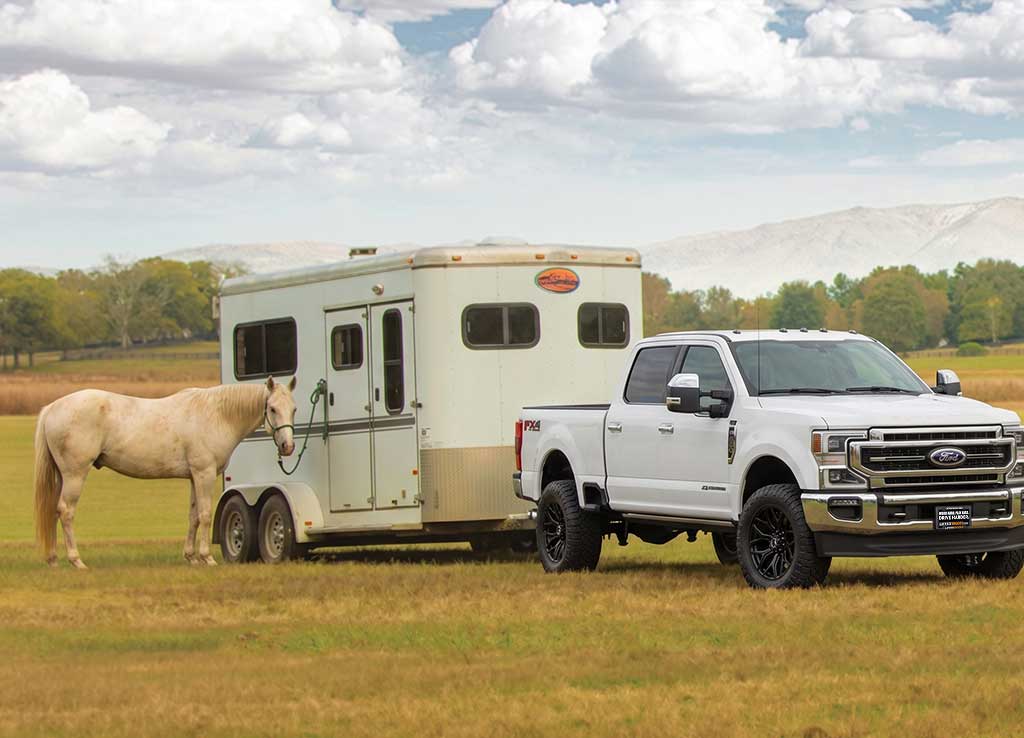
For many horse owners, that means deciding between two common trailer configurations: bumper-pull and gooseneck.
Both can be excellent options. Both are available in configurations capable of safely transporting horses. And both can range from relatively simple trailers to sophisticated setups loaded with tack storage, dressing rooms and other equipment.
But they interact with your truck very differently.
A bumper-pull places its hitch behind the truck's rear axle. A gooseneck connects inside the bed, typically near or slightly ahead of the rear axle.
That seemingly simple difference affects everything from maneuverability and stability to payload requirements, bed usability and the type of truck you should consider.
So before deciding whether you need an F-150 or F-350, a Silverado 1500 or 3500HD, a Ram 1500 or 3500—or anything in between—start with the trailer.
Here's what horse owners should know.
What Is a Bumper-Pull Horse Trailer?
Despite the name, a bumper-pull trailer isn't normally attached directly to the truck's bumper.
It connects to a receiver hitch mounted to the truck's frame, using a hitch and ball positioned behind the rear bumper.
You'll also hear this configuration called a tag-along trailer.
Bumper-pull horse trailers are extremely common, particularly among recreational riders and owners transporting one, two or sometimes several horses.
Their popularity makes sense.
They're relatively straightforward, don't require a hitch mounted inside the truck bed, and can be disconnected without leaving a large trailer structure over the bed.
For many horse owners, they're all the trailer they'll ever need.
What Is a Gooseneck Horse Trailer?
A gooseneck extends forward over the truck bed and connects to a ball mounted in the bed.
Instead of pulling from behind the rear bumper, the trailer's connection point sits much closer to the truck's rear axle.
This configuration is commonly used for larger horse trailers and becomes especially popular as trailer length, weight and cargo requirements increase.
Goosenecks can also provide substantial additional space.
The area extending over the truck bed can be used for storage, tack rooms, sleeping accommodations or incorporated into full living quarters.
Spend time around major horse shows, rodeos or equestrian competitions and you'll likely see plenty of them.
The Biggest Difference: Where the Trailer Connects
This is the mechanical distinction that drives many of the other differences between the two designs.
A bumper-pull connects behind the rear axle.
A gooseneck connects near the rear axle inside the bed.
Think of the truck's rear axle as a pivot point.
With a bumper-pull, the trailer has greater leverage on the truck because the hitch is located farther behind that pivot point.
With a gooseneck, the trailer load is transferred much closer to the axle.
That generally contributes to the stable towing characteristics that make goosenecks attractive for larger trailers.
But it also means substantially more trailer weight can be carried by the truck itself.
And that brings us to one of the most important numbers in horse-trailer towing.
Payload Matters—A Lot
Truck shoppers love talking about towing capacity.
Horse owners need to talk about payload, too.
Payload is the amount of weight the truck can carry.
That includes passengers, equipment, cargo in the bed and the portion of the trailer's weight being supported by the truck.
With a bumper-pull, that's generally called tongue weight.
With a gooseneck, it's commonly called pin or hitch weight.
Because goosenecks transfer a meaningful portion of their weight directly into the truck bed, available payload can become a limiting factor even when the truck has plenty of theoretical towing capacity.
This is why simply saying:
"My truck can tow 15,000 pounds."
doesn't tell you whether it's appropriately configured for a particular trailer.
You have to look at the entire combination.
Bumper-Pull Advantages
For many recreational horse owners, a bumper-pull is difficult to beat.
You Keep Your Truck Bed
This is one of the biggest practical advantages.
A bumper-pull hitch doesn't occupy the center of your bed.
That leaves the bed available for hay, tack boxes, water, camping equipment and everything else that tends to accumulate when horses are involved.
It also makes the truck easier to use for normal life when you aren't towing.
Simpler Truck Requirements
You don't need a gooseneck hitch installed in the bed.
A properly rated receiver, ball mount, hitch ball, trailer wiring and brake controller setup may be all that's required, depending on the truck and trailer.
That simplicity can make bumper-pull ownership appealing to someone who doesn't tow constantly.
More Vehicle Flexibility
Some lighter bumper-pull horse trailers can potentially be matched with properly configured half-ton trucks.
That opens the door to vehicles such as the Ford F-150, Chevrolet Silverado 1500, GMC Sierra 1500, Ram 1500 and Toyota Tundra.
But this comes with an important warning:
Just because a truck can pull the trailer doesn't automatically mean it's the best truck for the job.
Payload, tongue weight, passengers and equipment still need to be calculated.
Easier to Swap Tow Vehicles
Because receiver hitches are so common, bumper-pull trailers can often be used with multiple appropriately rated tow vehicles without specialized in-bed hardware.
That can be useful for households with more than one capable truck.
Bumper-Pull Trade-Offs
The biggest compromise comes from the hitch location.
Because the connection is behind the rear axle, trailer movement can exert more leverage on the tow vehicle.
Proper weight distribution, trailer loading, tire condition, suspension condition and appropriate hitch equipment become extremely important.
Wind, passing trucks and abrupt steering inputs can also make trailer stability more noticeable.
None of this means bumper-pull trailers are inherently unsafe.
Properly matched and correctly loaded combinations are used successfully every day.
It means that setup matters.
That's especially important when the cargo can move around on four legs.
Gooseneck Advantages
As trailers become larger and heavier, the gooseneck design begins to offer compelling advantages.
Stable Towing Characteristics
Moving the hitch point forward and closer to the rear axle changes how the trailer interacts with the truck.
The result is one reason goosenecks are so common for serious hauling.
For owners regularly traveling long distances with multiple horses, the towing experience itself can become a major factor.
Excellent Maneuverability
Goosenecks can turn at sharper angles relative to the truck than many bumper-pull combinations.
That can be extremely useful when maneuvering around barns, showgrounds, ranch properties and tight parking areas.
There is a learning curve, though.
The trailer responds differently when backing, and drivers transitioning from bumper-pulls need time to become comfortable with the geometry.
More Trailer Space
The structure extending over the truck bed gives trailer manufacturers valuable additional room.
That can translate into:
-
Additional tack storage
-
Dressing rooms
-
Sleeping areas
-
Bathrooms
-
Kitchens
-
Climate-controlled living spaces
-
Additional horse capacity
At the upper end, you're no longer talking about simply transporting horses.
You're essentially pulling a mobile equestrian base camp.
Well Suited to Serious Competition
For people regularly traveling to rodeos, horse shows, polo events, barrel races or other competitions, a gooseneck with living quarters can dramatically change the experience.
Instead of transporting horses and then finding separate accommodations, the trailer can carry the animals, equipment and living space together.
That's one reason these rigs are so common among serious competitors.
Gooseneck Trade-Offs
The additional capability comes with additional requirements.
You Lose Some Bed Space
The trailer extends over the bed and connects to an in-bed hitch.
That limits how the bed can be used while towing.
Some modern gooseneck hitch systems can be removed or folded away when not needed, but the trailer itself obviously occupies significant space above the bed while connected.
Payload Requirements Increase
This is arguably the biggest consideration.
Goosenecks can transfer substantial weight onto the truck.
Add passengers, tools, fuel and anything else carried by the vehicle, and a lightly configured truck can run out of payload sooner than expected.
That's one reason 3/4-ton and especially one-ton trucks are so common underneath larger gooseneck horse trailers.
Truck-Bed Clearance Matters
The underside of the gooseneck needs adequate clearance above the truck's bed rails.
This becomes particularly important with lifted trucks.
More on that shortly.
Half-Ton, 3/4-Ton or One-Ton?
There isn't a universal rule based solely on trailer style.
A lightweight bumper-pull may work with a properly equipped half-ton.
A larger bumper-pull may make a 3/4-ton the more appropriate platform.
A lightweight gooseneck could potentially fall within the ratings of certain trucks, while a large living-quarters trailer may call for a one-ton or dually.
The important thing is to stop thinking about truck classes as interchangeable simply because their advertised tow ratings overlap.
An HD truck offers more than a larger towing number.
Heavy-duty trucks generally bring greater payload capability, heavier-duty axles, brakes, frames, cooling systems, suspension components and other hardware designed around demanding use.
When your cargo includes horses, having appropriate capacity matters more than winning a numbers contest.
When Does a Dually Make Sense?
Move far enough up the horse-trailer spectrum and you'll inevitably encounter dual-rear-wheel trucks.
Ford F-350 and F-450 Super Duty, Chevrolet Silverado 3500HD, GMC Sierra 3500HD and Ram 3500 dually configurations are common sights around large equestrian trailers.
Why?
A dually places four tires across the rear axle instead of two.
Depending on configuration, this can provide significantly greater rear-axle and payload capability while also providing a wide, planted platform for heavy trailers.
For a modest two-horse bumper-pull, that's likely unnecessary.
For a large multi-horse living-quarters gooseneck carrying substantial pin weight, a dually can make much more sense.
Again, match the truck to the trailer.
Gas or Diesel?
Trailer configuration can influence this decision, too.
A lighter bumper-pull used locally may pair beautifully with a modern gasoline-powered truck.
As trailer size, weight, mileage and terrain increase, diesel becomes increasingly attractive.
Modern heavy-duty diesels offer enormous low-rpm torque and are particularly well suited to sustained heavy towing.
Diesel exhaust braking can also be valuable when controlling a loaded trailer on long descents.
That doesn't mean gooseneck automatically equals diesel.
It means larger goosenecks tend to create the kind of workload where diesel's strengths become more valuable.
Can You Tow a Bumper-Pull Horse Trailer With a Lifted Truck?
Yes—provided the truck and trailer are correctly configured.
The important issue is trailer attitude.
Raising the truck changes the height of the receiver relative to the trailer.
The correct hitch setup should position the trailer appropriately rather than leaving it significantly nose-high.
That may require a properly rated drop hitch.
But hitch height isn't the only consideration.
Tire load ratings, wheels, suspension modifications, receiver ratings and the truck's overall configuration all need to be appropriate for the load.
This is why professionally building a truck around its intended use matters.
What About a Gooseneck and a Lifted Truck?
This requires even more attention.
With a gooseneck, raising the truck also raises the bed rails relative to the trailer.
Adequate clearance must remain between the trailer and the truck bed throughout normal driving and articulation.
Too little clearance creates the possibility of the trailer contacting the bed rails when entering uneven terrain, crossing drainage areas, negotiating steep driveways or maneuvering around ranch property.
Simply raising the front of the trailer isn't necessarily the answer, either.
The trailer still needs to maintain appropriate geometry and axle loading.
If you plan to combine a lifted truck with a gooseneck horse trailer, the lift height, tire size, trailer geometry, hitch configuration and bed clearance should be evaluated together.
Don't Forget Trailer Brakes
Regardless of hitch type, a properly functioning trailer braking system is essential.
The truck's brakes shouldn't be expected to control the entire combination by themselves.
Many horse trailers use electric brakes controlled through the tow vehicle's trailer brake controller.
Modern trucks increasingly offer sophisticated factory towing technology, including integrated brake controllers, trailer profiles, camera systems, blind-spot features and trailer monitoring.
These aren't just convenience features when you're towing live animals.
They can make the entire combination easier to manage.
How Much Does Your Horse Trailer Actually Weigh?
Before buying a truck, determine the trailer's realistic loaded weight.
Not just its empty weight.
Add:
-
The horses
-
Saddles
-
Tack
-
Feed
-
Hay
-
Water
-
Equipment
-
Supplies
-
Personal belongings
-
Living-quarters cargo
Water deserves special attention because it's heavy.
A trailer that looks comfortably within your truck's capacity when empty can become substantially heavier when loaded for a weekend competition.
Whenever possible, weighing the loaded combination provides much better information than estimating.
Which Setup Is Right for You?
For many recreational horse owners, a bumper-pull offers the best combination of simplicity, versatility and capability.
If you're transporting one or two horses, traveling relatively short distances and still want full use of your truck bed, it can make tremendous sense.
As your requirements increase, the equation begins to shift.
If you're transporting multiple horses, traveling frequently, carrying substantial equipment or moving into living-quarters trailers, a gooseneck becomes increasingly attractive.
And as the trailer grows, your truck may need to grow with it—from half-ton to HD, from gas to diesel, or eventually from single-rear-wheel to dually.
The important thing isn't choosing the biggest truck.
It's choosing the right truck for the actual job.
Start With the Trailer, Then Choose the Truck
One of the easiest mistakes a horse owner can make is buying the truck first and figuring out the trailer later.
Reverse that process whenever possible.
Determine what you need to transport.
Choose the type and size of trailer that fits those requirements.
Understand its loaded weight and expected tongue or pin weight.
Then find a truck with the appropriate towing, payload, axle and combined-weight ratings—with enough capacity for passengers and equipment, too.
That approach produces a tow rig designed as a complete system.
And when you're transporting horses, that's exactly how it should be treated.
Find a Truck Built for Your Equestrian Lifestyle
Whether your ideal setup is a gas-powered HD truck pulling a two-horse bumper-pull or a diesel dually underneath a fully loaded living-quarters gooseneck, the right truck can transform the way you travel with your horses.
Lifted Trucks offers professionally built Ford, Chevrolet, GMC, Ram, Toyota and other trucks for drivers who need real capability without settling for an ordinary truck.
Our team can help you explore trucks that fit your towing needs while considering the modifications, tire configurations and equipment that matter when towing.
And you don't have to live near one of our dealerships to find the right truck. Lifted Trucks offers nationwide shipping, helping customers across the country find their next custom truck.