Ford 6.7 Power Stroke vs. 7.3 Godzilla: Diesel vs. Gas Super Duty
14 min de lectura
Choosing a Ford Super Duty often leads to one of the biggest questions in the heavy-duty truck world:
En este artículo
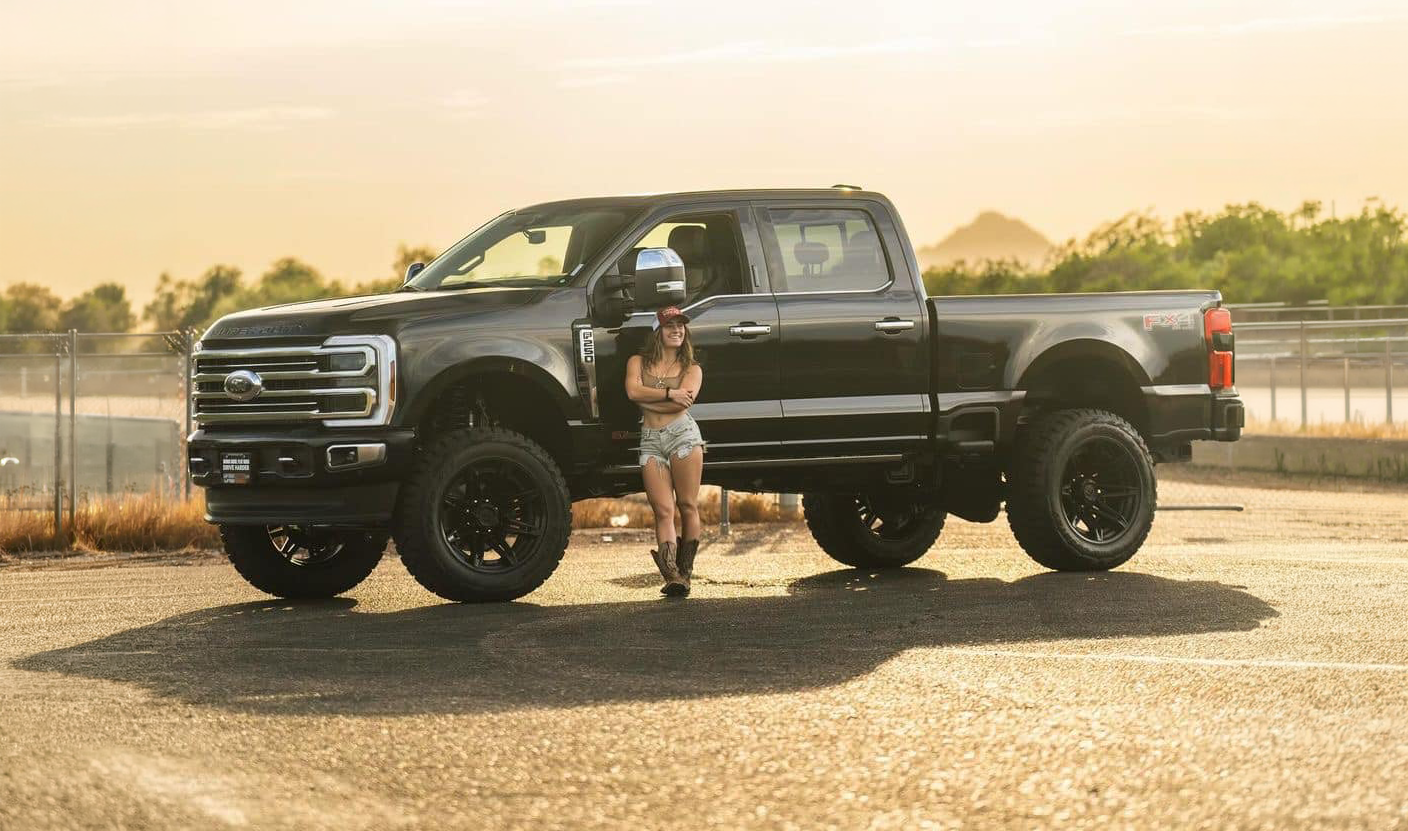
Should you buy the 6.7L Power Stroke diesel or the 7.3L Godzilla gas V8?
Both engines are designed for serious work, but they approach it very differently.
The 6.7L Power Stroke delivers the massive low-RPM torque, towing performance, and diesel characteristics that have made heavy-duty diesels popular with buyers who regularly pull substantial loads.
The 7.3L Godzilla takes a different approach. It's a large-displacement, naturally aspirated gasoline V8 designed to provide strong heavy-duty performance without the turbocharging, diesel emissions equipment, and other systems associated with a modern diesel powertrain.
For some buyers, the Power Stroke is unquestionably the right engine.
For others, paying more for a diesel they don't actually need makes little sense.
Here's how to decide.
6.7 Power Stroke vs. 7.3 Godzilla: The Short Answer
If you regularly tow very heavy trailers, travel long distances under load, or want the enormous low-RPM torque of a modern diesel, the 6.7L Power Stroke is generally the stronger choice.
If you want a capable Super Duty with lower initial powertrain cost, naturally aspirated gas-engine simplicity, and don't routinely need maximum towing performance, the 7.3L Godzilla can be the smarter choice.
The decision isn't simply diesel versus gas.
It's about matching the engine to the truck's actual duty cycle.
What Is the 6.7L Power Stroke?
Ford's 6.7L Power Stroke is a turbocharged diesel V8 developed specifically for Super Duty applications.
The Power Stroke's defining characteristic is torque.
Modern versions produce tremendous torque at relatively low engine speeds, which is exactly where a heavy-duty tow vehicle benefits from it. Instead of needing high RPM to move substantial weight, the diesel can apply significant torque while pulling a trailer, climbing grades, accelerating onto the highway, or maintaining speed under load.
Ford has continued developing the 6.7L platform over multiple generations, and current Super Duty lineups can include both standard-output and high-output versions depending on model year and configuration.
Exact horsepower and torque figures vary by year and version, so buyers should compare specifications for the particular Super Duty they're considering.
What Is the 7.3L Godzilla V8?
Ford's 7.3L gasoline V8 is commonly known by enthusiasts as the Godzilla.
Rather than using turbochargers or hybridization, Ford took a relatively traditional heavy-duty approach: substantial displacement, eight cylinders, and naturally aspirated gasoline power.
The 7.3L uses a pushrod architecture, allowing Ford to package a large-displacement engine in a relatively compact physical footprint.
More importantly for truck buyers, the engine was designed around heavy-duty use.
This isn't simply a performance-car engine transplanted into a pickup. Its power delivery and construction were developed for applications where trucks may spend significant amounts of time hauling, towing, idling, and working.
That makes the Godzilla an interesting alternative for buyers who want serious capability but don't necessarily need a diesel.
6.7 Power Stroke vs. 7.3 Godzilla Specifications
On paper, the largest difference is torque.
The Power Stroke produces dramatically more torque than the naturally aspirated 7.3L gasoline V8, particularly in modern high-output configurations.
But comparing peak numbers doesn't tell the whole story.
Diesel engines and gasoline engines deliver power differently.
The Power Stroke's huge torque output at low RPM is particularly useful when the truck is moving substantial weight.
The Godzilla generally operates across a broader RPM range and may downshift and rev higher while performing the same task.
Neither behavior is inherently bad.
They're simply different ways of doing the work.
Which Engine Is Better for Towing?
If maximum towing performance is the priority, the 6.7L Power Stroke has the advantage.
Its enormous low-end torque makes it particularly well suited for moving heavy trailers from a stop, climbing grades, maintaining highway speed, and towing through demanding terrain.
This becomes increasingly noticeable as trailer weight increases.
Someone towing a large fifth-wheel RV across the Rocky Mountains has very different powertrain requirements from someone pulling a 7,000-pound boat several weekends per year.
For moderate recreational towing, the 7.3 Godzilla can provide plenty of capability when installed in a properly configured Super Duty.
For frequent, very heavy towing, the Power Stroke begins to justify its additional cost and complexity.
Does That Mean You Need a Diesel to Tow?
No.
This is one of the most persistent misconceptions surrounding heavy-duty trucks.
Modern gasoline Super Duty trucks are extremely capable.
The 7.3 Godzilla can handle substantial trailers when the truck is properly configured and operated within its ratings.
The difference becomes more apparent as the workload gets heavier and more frequent.
A buyer towing occasionally may never realize enough practical benefit from the diesel to justify choosing it.
A buyer pulling heavy equipment or a large fifth wheel thousands of miles every year may appreciate the Power Stroke every time the trailer is connected.
Which Engine Is Better for Daily Driving?
For a Super Duty that spends most of its life unloaded, the 7.3 Godzilla deserves serious consideration.
Diesel engines are excellent at what they were designed to do, but many owners buy diesels primarily because they like diesels rather than because their workload requires one.
There's nothing wrong with that.
But from a purely practical standpoint, someone commuting to work, running errands, occasionally towing, and using the truck recreationally may not benefit as much from the Power Stroke's primary strengths.
The Godzilla provides strong power without requiring the owner to buy a diesel simply to drive a heavy-duty truck.
Which Engine Is Better for Short Trips?
A gasoline engine generally makes more sense when a truck routinely sees short trips and relatively light-duty operation.
Modern diesel emissions systems operate best when the truck regularly reaches appropriate operating temperatures and experiences driving conditions that allow the emissions system to function as designed.
Repeated short-distance operation can be less ideal for some diesel duty cycles.
A gasoline engine avoids diesel particulate filter regeneration and diesel exhaust fluid requirements entirely.
For a truck that spends its life traveling five miles to work, making short trips around town, and occasionally towing recreational equipment, the Godzilla can therefore be particularly appealing.
Power Stroke vs. Godzilla Fuel Economy
The diesel will generally have an efficiency advantage under many comparable heavy-duty operating conditions, particularly under load.
However, fuel economy alone doesn't determine which engine costs less to own.
Diesel fuel prices vary.
The Power Stroke also carries a substantial initial price premium compared with a gasoline engine.
A buyer therefore shouldn't simply ask:
Which engine gets better MPG?
A better question is:
Will I drive and tow enough for the diesel's efficiency and capability advantages to offset its higher acquisition and ownership costs?
For some owners, absolutely.
For others, probably not.
Power Stroke vs. Godzilla Maintenance Costs
This is one of the Godzilla's strongest arguments.
A modern diesel powertrain contains systems that a naturally aspirated gasoline engine doesn't require.
Depending on model year and configuration, diesel ownership can involve components and systems related to:
- Turbocharging
- High-pressure diesel fuel injection
- Diesel particulate filtration
- Selective catalytic reduction
- Diesel exhaust fluid
- Exhaust-gas recirculation
- Additional emissions-control hardware
That doesn't make the Power Stroke unreliable.
It means the diesel is mechanically and electronically more complex because it is being asked to deliver exceptional heavy-duty performance while meeting modern emissions requirements.
When something does require repair, certain diesel components can also be expensive.
The Godzilla's naturally aspirated gasoline architecture eliminates several of those diesel-specific systems.
For buyers who don't need diesel capability, that can be a meaningful long-term ownership advantage.
Does the 7.3 Godzilla Require Less Maintenance?
Not necessarily less maintenance in every respect, but it offers a simpler maintenance proposition.
Both engines require proper oil changes, cooling-system maintenance, filtration, inspections, and adherence to Ford's recommended service schedule.
The Power Stroke adds diesel-specific considerations such as fuel filtration and DEF, along with the operational requirements associated with its emissions system.
Maintenance cost also depends heavily on how the truck is used.
A commercial Power Stroke towing every day should not be compared directly with a lightly driven gasoline Super Duty that spends most of its life empty.
Duty cycle matters.
Which Engine Lasts Longer?
There isn't a responsible universal mileage number for either engine.
Power Stroke diesels are engineered for demanding heavy-duty use and can accumulate substantial mileage when properly maintained.
The 7.3 Godzilla was also designed as a heavy-duty engine rather than simply a light-duty passenger-vehicle powerplant.
Real-world longevity depends on:
- Maintenance
- Oil-change intervals
- Operating temperature
- Towing frequency
- Trailer weight
- Idle time
- Driving conditions
- Modification history
- Previous ownership
- Cooling-system condition
A well-maintained gasoline truck can be a better purchase than a neglected diesel, and vice versa.
When shopping used, maintenance history and vehicle condition should carry significant weight.
Which Engine Is More Reliable?
"Which is more reliable?" is another question that sounds simple but isn't.
The Godzilla's naturally aspirated gasoline design has an inherent complexity advantage because it doesn't need a turbocharger, high-pressure diesel injection system, DPF, DEF/SCR system, or other diesel-specific equipment.
That means there are fewer diesel-specific systems capable of generating expensive repairs.
But fewer components do not automatically guarantee greater reliability.
The Power Stroke is designed specifically for heavy-duty diesel service and has been developed over many years.
For buyers comparing used trucks, model year, maintenance history, mileage, modifications, idle hours, towing history, and condition may be more useful than judging the engines solely by reputation.
Which Engine Is Better for High Mileage?
This depends on what "high mileage" means.
If you drive enormous highway mileage while frequently towing substantial loads, the Power Stroke makes a compelling argument.
That's exactly the type of environment where diesel efficiency, low-RPM torque, and heavy-duty performance become valuable.
If you accumulate high mileage primarily through unloaded commuting, the equation becomes less obvious.
The diesel's strengths aren't being exploited to the same degree.
High mileage alone doesn't justify a diesel.
High mileage combined with heavy workload is where the Power Stroke becomes especially compelling.
Which Engine Is Better for a Lifted Super Duty?
Both engines work extremely well in lifted F-250 and F-350 builds.
The Power Stroke's enormous torque is especially useful once larger and heavier wheels and tires are added.
Increasing tire diameter changes effective gearing, while heavier wheel-and-tire combinations require more energy to accelerate.
A diesel's low-RPM torque can help a heavy lifted truck feel effortless despite those changes.
But the Godzilla shouldn't be dismissed.
The 7.3L's substantial displacement provides strong gasoline performance, and its naturally aspirated power delivery makes it an excellent foundation for a lifted Super Duty that will primarily serve as a daily driver, recreational truck, or occasional tow vehicle.
The engine shouldn't be chosen based on the lift alone.
Choose it based on what the lifted truck will actually do.
What About 37-Inch Tires?
Large tires make proper drivetrain configuration increasingly important.
A 37-inch tire has a larger rolling diameter than most factory Super Duty tires and may also be substantially heavier depending on the tire and wheel combination.
That affects effective gearing and rotating mass.
The Power Stroke has enough torque that the performance impact can feel less dramatic, but torque doesn't repeal physics.
Proper axle gearing, wheel weight, tire construction, suspension geometry, alignment, braking, and intended towing use should all be considered.
The same applies to the Godzilla.
A professionally designed 37-inch-tire build should be treated as a complete vehicle system rather than simply fitting the largest tire that clears the fenders.
Which Is Better for an F-250?
For many F-250 buyers, the 7.3 Godzilla may actually represent the sweet spot.
An F-250 already provides substantial heavy-duty capability.
Pairing it with the Godzilla creates a truck capable of towing and hauling serious loads without automatically moving into diesel ownership.
The Power Stroke becomes increasingly compelling when an F-250 is purchased specifically for frequent heavy towing.
Ask yourself how often the trailer will actually be attached.
If the answer is "a few weekends per year," the Godzilla deserves a hard look.
If the answer is "several days every week," the Power Stroke's strengths become much easier to justify.
Which Is Better for an F-350?
The answer depends even more heavily on workload.
An F-350 may be purchased because the owner needs additional payload, fifth-wheel capability, gooseneck capability, or commercial hauling capacity.
Those use cases often overlap naturally with the strengths of the Power Stroke.
But not every F-350 is constantly towing.
An F-350 with a 7.3 Godzilla can still make tremendous sense for buyers who need the truck's payload or chassis capability but don't require diesel torque.
Engine choice and truck classification solve different problems.
Power Stroke vs. Godzilla for Fifth-Wheel Towing
For frequent large fifth-wheel towing, we'd generally lean toward the Power Stroke.
Fifth-wheel trailers can be heavy, and sustained highway towing exposes the differences between gasoline and diesel powertrains more clearly than unloaded driving does.
The Power Stroke's torque allows the truck to pull substantial loads at relatively low engine speeds and provides excellent performance on grades.
The Godzilla can still be a perfectly legitimate fifth-wheel tow engine when the trailer and truck are appropriately matched.
The deciding factors should be actual loaded trailer weight, pin weight, terrain, towing frequency, and annual mileage.
Power Stroke vs. Godzilla for Ranching and Farm Use
This one can go either way.
A ranch or farm truck that regularly pulls livestock, equipment, hay, or heavy gooseneck trailers may make excellent use of the Power Stroke.
A truck that spends more time checking property, carrying tools, driving short distances, idling, and occasionally towing may be better suited to the Godzilla.
The environment matters just as much as the maximum load.
The best ranch truck isn't necessarily the one capable of pulling the heaviest trailer.
It's the one whose powertrain best matches what it does every day.
Power Stroke vs. Godzilla for Construction and Work Trucks
Commercial users should think in terms of utilization.
If a Super Duty earns its living pulling heavy equipment every day, diesel capability can be a business asset.
If the truck primarily transports crews and tools while towing occasionally, the lower initial cost and gasoline powertrain of the Godzilla may produce a more attractive ownership equation.
Fleet operators have understood this distinction for decades.
The most capable engine isn't automatically the most cost-effective engine.
Does the Power Stroke Have Better Resale Value?
Diesel Super Duty trucks have historically commanded strong demand in the used heavy-duty market, particularly among buyers seeking tow vehicles.
That can help support resale value.
However, the truck's condition, mileage, service history, trim, configuration, market conditions, modifications, and regional demand all affect resale.
A diesel's higher resale price should also be considered alongside its higher original purchase price.
Resale value is one part of total ownership cost—not the entire calculation.
Is the 7.3 Godzilla Better Because It's Simpler?
For some owners, yes.
There is legitimate value in mechanical simplicity.
No turbochargers.
No diesel particulate filter.
No diesel exhaust fluid.
No diesel-specific high-pressure fuel system.
But simplicity shouldn't be confused with superiority.
Those additional systems exist on the Power Stroke because the engine provides capabilities the naturally aspirated gasoline V8 cannot duplicate.
The question is whether you need those capabilities.
If you do, the additional complexity may be a perfectly reasonable tradeoff.
If you don't, paying for that complexity becomes harder to justify.
When Is the Power Stroke Worth the Extra Money?
The diesel begins making the strongest case when several of these apply:
- You tow heavy frequently
- You tow long distances
- You routinely travel through mountainous terrain with a trailer
- You accumulate substantial annual mileage under load
- You tow large fifth-wheel or gooseneck trailers
- Low-RPM torque is important to your workload
- Your truck is used commercially
- Diesel resale demand matters to you
The more boxes you check, the easier the Power Stroke becomes to justify.
When Is the 7.3 Godzilla the Better Buy?
The Godzilla becomes especially attractive when:
- The truck is primarily a daily driver
- You tow occasionally rather than constantly
- Your trailers are well within the truck's capabilities
- You make frequent short trips
- You want lower initial powertrain cost
- You prefer naturally aspirated gasoline power
- You want to avoid diesel-specific maintenance and emissions systems
- You're building a lifted lifestyle truck rather than a dedicated tow rig
For this buyer, the Godzilla isn't the "budget engine."
It may simply be the engine better matched to the job.
6.7 Power Stroke vs. 7.3 Godzilla: Which Should You Buy?
Here's the simplest answer.
Choose the 6.7L Power Stroke if your Super Duty regularly works like a Super Duty.
Heavy trailers, substantial annual towing mileage, steep grades, fifth wheels, goosenecks, equipment, and commercial workloads allow the diesel to demonstrate why it exists.
Choose the 7.3L Godzilla if you want Super Duty capability without needing maximum diesel performance.
Daily driving, recreational use, moderate towing, short trips, and lifted lifestyle builds can make the large gasoline V8 an extremely compelling choice.
There is no universally superior engine.
There is only the engine that better matches your use.
The Biggest Mistake Is Buying the Engine You Think You're Supposed to Buy
Heavy-duty truck culture has long treated diesel as the ultimate option.
And for the right owner, it is.
But buying a Power Stroke simply because "real Super Dutys are diesel" ignores the economics and engineering behind these trucks.
Likewise, choosing the Godzilla simply because gasoline engines cost less ignores the enormous advantage a diesel provides when substantial weight gets hooked to the truck regularly.
Start with the workload.
How heavy do you tow?
How often?
How far?
Where?
How many miles do you drive annually?
How much time does the truck spend unloaded?
Answer those questions honestly and the Power Stroke-versus-Godzilla decision becomes much easier.
Explore Ford Super Duty Trucks at Lifted Trucks
Whether you're looking for the massive torque of a 6.7L Power Stroke or the naturally aspirated capability of a 7.3L Godzilla, Lifted Trucks can help you find a Ford Super Duty configured around how you actually intend to use it.
Explore our selection of F-250 and F-350 Super Duty trucks, including professionally lifted and customized builds with carefully selected suspension, wheel, and tire combinations.
Qualifying Lifted Trucks-installed modifications are backed by our lifetime labor warranty for as long as you own the vehicle, while applicable parts carry their respective manufacturer warranties.
And your search isn't limited to what's available locally. Lifted Trucks offers nationwide shipping, giving you access to our broader selection of custom Ford Super Duty trucks from across the country.