F-250 vs. F-350: What’s the Difference and Which Ford Super Duty Should You Buy?
11 min read
The Ford F-250 and F-350 Super Duty can look remarkably similar sitting next to each other. They share much of their styling, offer many of the same engines and trims, and can both be configured as extremely capable work trucks, tow vehicles, luxury pickups, or lifted custom builds.
In this article
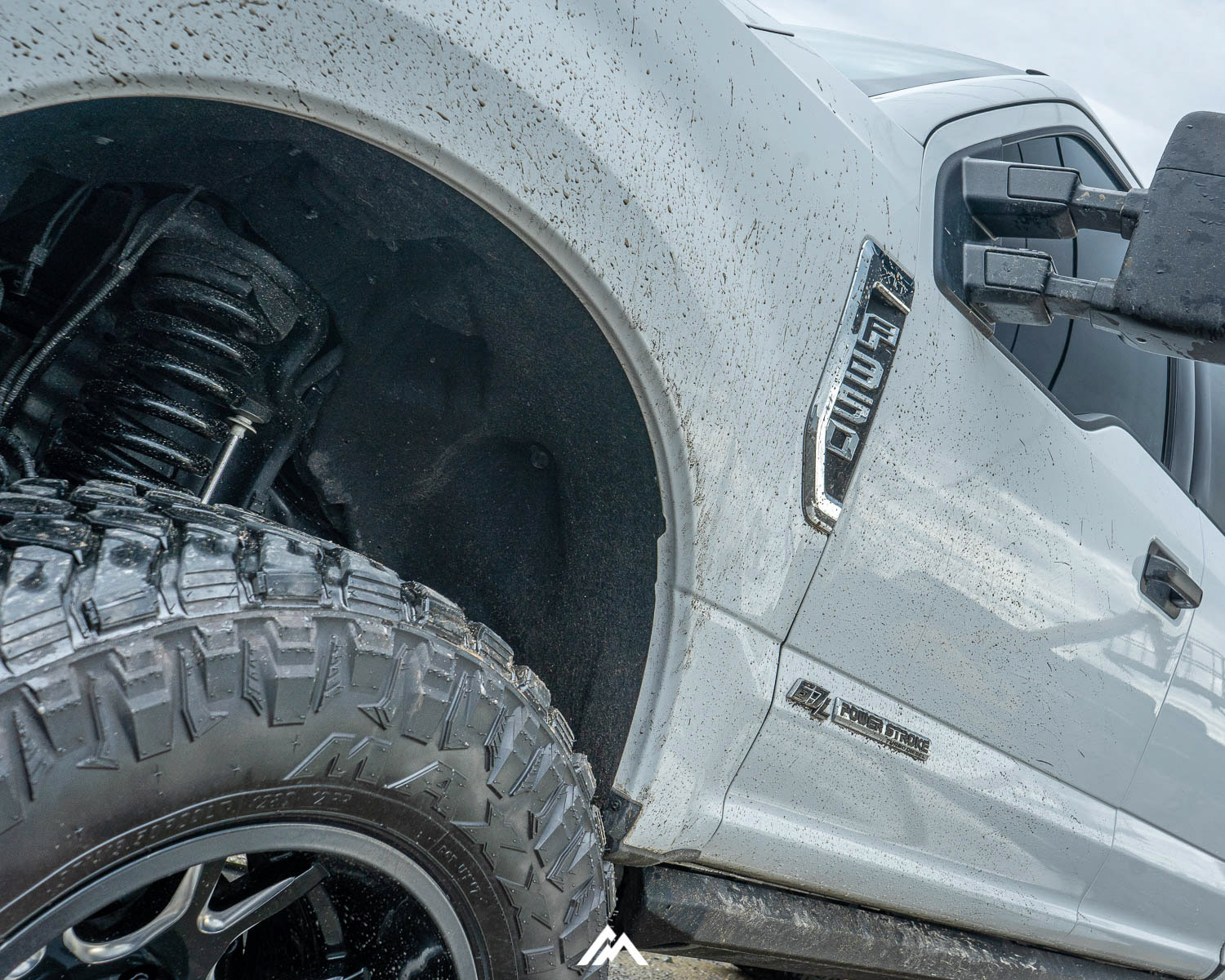
So why buy an F-350 instead of an F-250?
The biggest differences between the F-250 and F-350 involve their weight ratings, payload and towing potential, suspension configurations, and available single-rear-wheel and dual-rear-wheel setups. For many buyers, the decision isn't about which truck is "better." It's about how much capability they actually need.
If you're deciding between an F-250 and F-350, here's what matters.
F-250 vs. F-350: The Short Answer
The Ford F-250 is generally the better choice for buyers who want serious Super Duty capability while still prioritizing everyday usability.
The F-350 is designed to provide greater potential payload and towing capability, particularly when configured for demanding commercial use, large fifth-wheel or gooseneck trailers, or other heavy loads.
For many recreational users, the F-250 provides more than enough truck.
For buyers regularly approaching the limits of an F-250's payload or towing ratings, stepping up to an appropriately configured F-350 can provide valuable additional capacity.
The important word is "configured."
An F-350 badge does not automatically mean every F-350 can tow or carry more than every F-250. Cab style, drivetrain, engine, axle ratio, wheelbase, single- or dual-rear-wheel configuration, GVWR and optional equipment can substantially change the capabilities of an individual truck.
Always evaluate the specifications of the exact vehicle.
What Is Ford Super Duty?
Ford uses the Super Duty name for its heavy-duty pickup platform, including the F-250, F-350 and larger commercial models.
Compared with the F-150, Super Duty trucks are engineered around significantly heavier workloads. Depending on configuration, that means stronger chassis components, heavy-duty axles and suspension, higher weight ratings, and powertrains designed for substantial towing and hauling.
That makes the F-250 and F-350 popular far beyond traditional commercial fleets.
You'll find Super Duty trucks towing fifth-wheel campers, hauling equipment, working ranches, pulling horse trailers, carrying slide-in campers, traveling to remote job sites and serving as the foundation for premium lifted builds.
What Is the Main Difference Between an F-250 and F-350?
The fundamental difference is capability.
An F-350 can be configured with higher gross vehicle weight ratings and greater payload and towing potential than an F-250.
The F-350 is also available in configurations designed specifically for exceptionally demanding loads, including dual-rear-wheel models.
However, the two trucks overlap considerably.
A heavily optioned F-250 and a single-rear-wheel F-350 can feel much more similar in normal driving than their badges might suggest.
That is why shoppers should look beyond the model designation and understand what they're actually asking the truck to do.
F-250 vs. F-350 Payload
Payload is one of the most important differences between these trucks.
Payload isn't simply how much cargo you can throw in the bed.
Everything added to the truck beyond its rated empty configuration can consume available payload, including:
- Driver and passengers
- Cargo
- Tools
- Accessories
- Trailer tongue weight
- Fifth-wheel or gooseneck pin weight
- Certain aftermarket equipment
This becomes especially important with large trailers.
A trailer can be within a truck's advertised maximum towing capability while still creating enough tongue or pin weight to exceed the truck's payload or other ratings.
An F-350's higher available weight ratings can therefore make a meaningful difference for buyers carrying substantial loads or towing trailers that place significant weight over the rear axle.
F-250 vs. F-350 Towing Capacity
Both trucks can be formidable tow vehicles.
Depending on configuration, Ford Super Duty trucks can be equipped for conventional bumper-pull towing as well as fifth-wheel and gooseneck towing.
The F-250 is capable enough for many boats, equipment trailers, travel trailers and recreational towing situations.
The F-350 becomes increasingly attractive as trailer weight and especially pin weight increase.
That distinction matters because buying a tow vehicle should never be based solely on the largest towing number printed in an advertisement.
A proper towing evaluation should consider:
- Gross Vehicle Weight Rating
- Gross Combined Weight Rating
- Payload capacity
- Front and rear Gross Axle Weight Ratings
- Trailer weight
- Tongue or pin weight
- Hitch rating
- Passenger and cargo weight
- Tire ratings
- Vehicle configuration
Maximum advertised towing figures generally apply only to specific configurations.
Check the certification labels, owner's information and current Ford towing documentation for the individual truck and trailer combination.
Do the F-250 and F-350 Have the Same Engines?
Depending on model year and configuration, the F-250 and F-350 share many of the same Super Duty engine choices.
Modern examples can include Ford's large-displacement gasoline V8 engines and 6.7L Power Stroke diesel variants.
That means stepping from an F-250 to an F-350 does not necessarily mean you're buying a more powerful engine.
Instead, you're primarily moving into a truck that can be configured around higher vehicle and load ratings.
This is an important distinction.
An F-250 and F-350 equipped with similar powertrains may deliver similar engine performance while still having different legal and engineered capacities.
Gas vs. Diesel F-250 and F-350
Engine choice is almost a separate decision from choosing between an F-250 and F-350.
Gasoline Super Duty engines can make excellent sense for buyers who want heavy-duty capability without necessarily needing the characteristics of a diesel.
Diesel engines become particularly compelling for frequent heavy towing because of their substantial torque, especially under sustained load and at lower engine speeds.
A diesel may make sense for someone routinely towing a large fifth wheel across the country.
A gasoline Super Duty may make more sense for someone who wants HD capability but spends most of the time commuting, working locally, hauling moderate loads or simply enjoying the truck.
The right answer depends on duty cycle, not just maximum output.
F-250 vs. F-350 Ride Quality
Neither truck should be expected to ride exactly like an F-150.
Heavy-duty trucks require suspension components capable of managing significantly greater loads. That capability can produce a firmer ride when the truck is unloaded.
Differences between an F-250 and F-350 can depend heavily on configuration.
A single-rear-wheel F-350 used as a daily driver is a very different vehicle from an F-350 dual-rear-wheel truck configured around maximum towing and payload.
Tire pressure, wheel and tire choice, suspension configuration, wheelbase, cab style, payload and aftermarket modifications can also significantly influence ride quality.
If ride comfort is a major priority, drive the specific configuration you're considering rather than assuming every Super Duty feels the same.
F-250 vs. F-350 for Daily Driving
For buyers who don't need the F-350's additional capability, an F-250 often represents the more logical daily-driver choice.
It provides the substantial feel, capability and presence people want from a Super Duty without automatically moving into a more specialized heavy-hauling configuration.
However, a single-rear-wheel F-350 can still be perfectly usable as a daily driver.
The biggest everyday considerations aren't necessarily the difference between the badges. They're the realities of driving any large heavy-duty truck:
- Overall length
- Width
- Turning radius
- Parking
- Ride quality
- Fuel consumption
- Tire replacement costs
- Garage clearance
- Vehicle height, especially when lifted
If you already enjoy driving a Super Duty-sized truck, the difference between certain F-250 and F-350 configurations may be less dramatic than expected.
What Is an F-350 SRW?
SRW means single rear wheel.
An F-350 SRW has one wheel on each side of the rear axle, much like an F-250.
This configuration is popular among buyers who need more capability than an F-250 can provide but don't require a dual-rear-wheel truck.
An F-350 SRW can also be attractive for custom builds because it maintains the conventional pickup-truck proportions many enthusiasts prefer.
For buyers trying to balance capability, appearance and everyday usability, the F-350 SRW deserves serious consideration.
What Is an F-350 DRW?
DRW means dual rear wheel, commonly called a dually.
Instead of one rear tire per side, a dually uses two.
The wider rear footprint and increased tire capacity help support heavy loads and improve stability when towing appropriately matched trailers.
F-350 dually configurations are especially relevant for buyers towing large fifth wheels, gooseneck trailers, heavy equipment or other substantial loads.
But that capability comes with tradeoffs.
A dually is wider, takes more room to park, has additional tires to replace and is generally less convenient in tight urban environments.
If you don't need the capability, buying a dually simply because it is the "biggest" option may add inconvenience without providing meaningful benefit.
F-250 vs. F-350 for Fifth-Wheel Towing
This is one situation where the F-350 can become particularly compelling.
Large fifth-wheel trailers can place substantial pin weight directly into the truck bed.
That means payload capacity can become the limiting factor before maximum advertised trailer weight does.
For lighter fifth wheels, a properly configured F-250 may provide adequate capacity.
As trailer size and pin weight increase, an F-350—particularly an appropriately configured F-350 SRW or DRW—may provide the additional ratings needed.
Never select a tow vehicle from trailer dry weight alone.
Use realistic loaded trailer weight and expected pin weight, then compare those numbers against the exact truck's ratings.
F-250 vs. F-350 for a Slide-In Truck Camper
Truck campers create another payload-heavy use case.
Unlike a conventional trailer, much of a slide-in camper's weight is carried directly by the truck.
Once passengers, water, propane, gear, batteries and accessories are added, the real-world payload requirement can become substantial.
An F-350's additional available payload can therefore be extremely valuable for larger campers.
This is another example of why payload often matters more than horsepower when choosing between an F-250 and F-350.
F-250 vs. F-350 for Ranching and Work
Both trucks are excellent platforms for demanding work.
An F-250 may be ideal for:
- Construction
- Farm use
- Service work
- Moderate equipment towing
- Boat towing
- Landscaping
- General ranch duties
An F-350 becomes increasingly attractive for:
- Heavy equipment trailers
- Large horse and livestock trailers
- Gooseneck towing
- High payload requirements
- Large fifth wheels
- Commercial hauling
- Slide-in campers
- Repeated heavy-duty use
Again, the decision should be based on the load rather than the badge.
Which Is Better for a Lifted Truck: F-250 or F-350?
Both platforms make excellent lifted trucks.
Their large bodies, substantial chassis and heavy-duty proportions pair naturally with larger wheels and tires.
But modifications need to be considered in relation to how the truck will be used.
If the truck is primarily a daily driver, recreational vehicle or lifestyle build, either platform can work extremely well.
If it will regularly tow or haul near its limits, modifications deserve more careful consideration.
Larger tires, different wheels, suspension changes and increased ride height can influence:
- Effective gearing
- Braking performance
- Steering feel
- Suspension geometry
- Trailer geometry
- Hitch height
- Aerodynamics
- Fuel economy
- Overall vehicle height
A lifted truck's original certification ratings don't simply increase because aftermarket suspension components are installed.
That is why a properly engineered build matters.
The goal isn't simply to make a Super Duty taller. It's to create a complete truck where suspension, wheel and tire fitment, alignment and intended use work together.
F-250 vs. F-350 on 35s or 37s
Both Super Duty platforms are popular foundations for 35-inch and 37-inch tire builds.
But tire diameter is only part of the equation.
Wheel width, offset, backspacing, suspension design, lift height, steering clearance, axle gearing and intended suspension travel all influence proper fitment.
Larger tires also add rotating mass and can alter effective gearing.
This matters especially when towing.
A truck that spends most of its life cruising empty can tolerate different compromises than one routinely pulling a heavy trailer through mountainous terrain.
The best-looking setup isn't necessarily the best setup for every application.
Does an F-350 Get Worse Fuel Economy Than an F-250?
Not necessarily.
Fuel economy depends on much more than whether the badge says F-250 or F-350.
Engine, axle ratio, drivetrain, vehicle weight, tires, aerodynamics, speed, towing, payload and driving habits all matter.
A lifted F-250 on heavy aggressive tires could easily consume more fuel than a relatively stock F-350 under different operating conditions.
For heavy-duty trucks, fuel economy should be evaluated in the context of the entire configuration.
Does an F-350 Cost More to Own?
Potentially, but not always by as much as buyers assume.
Purchase price can be higher depending on configuration, and dual-rear-wheel trucks add additional tires and potentially higher operating costs.
Insurance and registration costs may also differ depending on the truck, weight classification and jurisdiction.
But an F-350 that is properly matched to a heavy workload can be less expensive than buying an undersized truck and later discovering that more payload or towing capacity is needed.
Buying enough truck the first time can matter.
Buying far more truck than you'll ever use can also be unnecessary.
Is an F-350 Stronger Than an F-250?
In terms of available rated capability, yes—the F-350 can be configured for greater payload and towing demands.
But "stronger" can be misleading.
The trucks share many components and powertrain choices depending on configuration and model year. The F-350's advantage lies primarily in how the complete vehicle is engineered, equipped and rated to handle additional load.
Think of the F-350 as providing a higher capability ceiling rather than simply being an F-250 with more horsepower.
Should You Buy an F-250 or F-350?
For most buyers, the decision can be simplified:
Choose the F-250 if you want serious heavy-duty capability, regularly tow or haul substantial loads, but don't need the additional payload or towing potential of an F-350.
Choose the F-350 SRW if you need greater available capacity but still want conventional pickup proportions and everyday usability.
Choose the F-350 DRW if your workload involves substantial fifth-wheel, gooseneck, commercial or payload demands where its additional capability and stability provide a real benefit.
Don't buy based solely on horsepower.
Don't buy based solely on the largest advertised towing number.
And don't automatically assume bigger is better.
Buy the truck whose actual configuration matches the work you're asking it to perform.
F-250 vs. F-350: The Bottom Line
The Ford F-250 and F-350 are closely related trucks designed for different levels of heavy-duty demand.
The F-250 occupies a particularly useful middle ground: significantly more capability than a half-ton pickup while remaining practical enough for daily driving, recreation, towing and custom builds.
The F-350 raises the capability ceiling. For large fifth wheels, heavy goosenecks, substantial payloads and demanding work, that additional capacity can make it the right tool for the job.
For lifted-truck buyers, both are outstanding foundations.
What matters most is building—and buying—the truck around its intended use.
Explore Ford Super Duty Trucks at Lifted Trucks
At Lifted Trucks, we specialize in trucks that combine heavy-duty capability with professionally selected suspension, wheel and tire packages designed to create a complete build.
Explore our selection of Ford F-250 and F-350 Super Duty trucks to compare engines, trims, configurations and custom builds and find the truck that fits your lifestyle.
Whether you're looking for a lifted F-250 daily driver, a diesel Super Duty for towing, or an F-350 built around serious capability, our team can help you find the right combination.
And your search isn't limited to your local market. Lifted Trucks offers nationwide shipping, making it easier to find the right Super Duty from across our broader inventory.