Diesel vs. Gas Trucks for Horse Owners: Which Makes More Sense?
9 min read
Choosing between a diesel and gas truck is one of the biggest decisions a horse owner can make when putting together a towing setup.
In this article
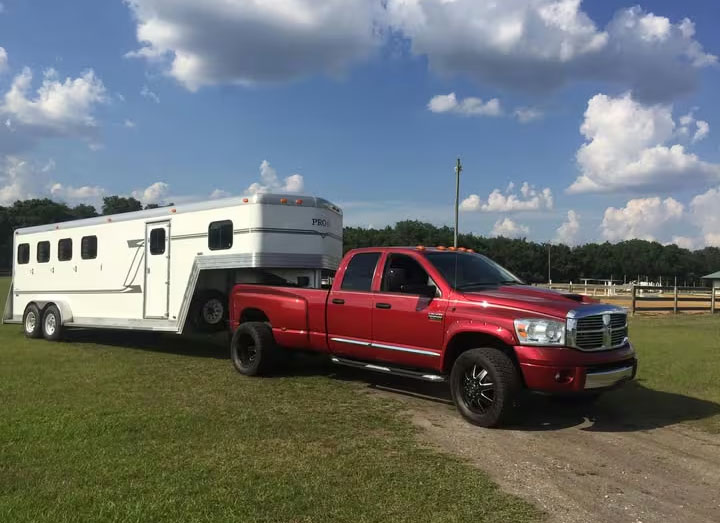
Both can be excellent choices. Both can safely pull horse trailers when properly configured. And despite what you might hear around the barn, you don't automatically need a diesel just because horses are involved.
The better question is this:
How much trailer are you pulling, how often are you pulling it, and where are you going?
A horse owner occasionally towing a two-horse bumper-pull trailer has very different requirements than someone regularly hauling four horses in a loaded living-quarters gooseneck across multiple states.
Understanding that difference can help you choose a truck that isn't simply capable of pulling your trailer, but is well suited to the way you actually use it.
Why Towing Horses Is Different
A horse trailer isn't just another trailer.
Your cargo moves.
A horse can shift its weight, adjust its stance and react to braking, acceleration, corners, road conditions and sudden maneuvers. That makes smooth, predictable vehicle behavior particularly important.
Horse owners also tend to carry considerably more than the horses themselves.
Depending on the trip, your total load may include:
-
Horses
-
Saddles and tack
-
Feed and hay
-
Water
-
Grooming equipment
-
Portable fencing or panels
-
Tools
-
Luggage
-
Passengers
-
Equipment stored in the truck bed
-
Living-quarters supplies
That's why evaluating a tow vehicle based only on its advertised maximum towing capacity can be misleading.
Payload, hitch weight, Gross Vehicle Weight Rating (GVWR), Gross Combined Weight Rating (GCWR), axle ratings and the truck's specific configuration all matter.
Once those requirements are understood, the diesel-versus-gas decision becomes much easier.
The Case for a Gas Truck
Modern heavy-duty gas engines are remarkably capable.
Today's gas-powered 3/4-ton and 1-ton trucks can handle towing jobs that would have pushed older trucks to their limits. For many recreational horse owners, that means diesel is no longer the default answer.
Gas trucks tend to make the most sense when towing is occasional or moderate rather than a constant part of the truck's life.
Imagine an owner with a two-horse bumper-pull trailer who travels locally for lessons, trail rides and occasional shows.
A properly equipped gas-powered heavy-duty truck may be more than enough.
Lower Initial Cost
One of the biggest advantages of gas is simplicity at the time of purchase.
A diesel engine is typically a significant upgrade over the standard gas powertrain in a heavy-duty truck. Choosing gas can leave thousands of dollars available for other things that matter to horse owners—such as a better trailer, towing equipment, truck accessories or simply a newer or better-equipped vehicle.
Simpler Maintenance
Modern diesel engines are incredibly sophisticated, but that sophistication brings additional systems and maintenance requirements.
Diesel trucks may incorporate diesel exhaust fluid, diesel particulate filters, selective catalytic reduction systems, turbocharging and other emissions and fuel-system components.
A gas engine generally has fewer diesel-specific systems to maintain.
For owners who mostly make short trips around town and occasionally tow horses, that simplicity can be attractive.
Better Suited to Short-Trip Use
Diesels shine when they're worked.
Regular highway driving and sustained towing allow the powertrain and emissions systems to reach normal operating temperatures.
If your truck spends most of its life making short trips between the house, barn and feed store, with only occasional towing, a gas engine may fit that usage pattern better.
Plenty of Power for Many Horse Trailers
Don't confuse "gas" with "underpowered."
Modern heavy-duty gasoline engines produce substantial horsepower and torque.
Depending on the truck and configuration, a gas-powered F-250, F-350, Silverado HD, Sierra HD or Ram Heavy Duty can provide serious towing capability.
The key is matching the specific truck to the actual loaded trailer—not choosing based solely on fuel type.
Where Diesel Starts to Make Sense
Add more horses.
Add a larger trailer.
Add living quarters.
Start traveling hundreds of miles.
Throw in mountain passes.
Now the equation changes quickly.
Diesel engines are particularly well suited to moving substantial weight for extended periods.
Torque Is the Big Difference
Horsepower gets plenty of attention, but torque becomes extremely important when moving a heavy combination from a stop, climbing grades or maintaining speed under load.
Modern heavy-duty diesel engines produce enormous amounts of low-rpm torque.
That doesn't necessarily mean the diesel truck can legally tow more in every configuration. Ratings depend on the complete vehicle.
What it does mean is that a properly equipped diesel HD truck can make heavy towing feel considerably less demanding.
That's especially noticeable with large gooseneck and living-quarters horse trailers.
Diesel Excels on Long Trips
If you're regularly traveling to shows, rodeos, polo matches, competitions, trail-riding destinations or equestrian events several states away, diesel becomes increasingly attractive.
Long highway trips put the engine directly into the environment where diesel powertrains tend to perform well.
The combination of low-rpm torque and heavy-duty powertrain characteristics makes sustained towing one of diesel's natural strengths.
For someone towing horses 50 miles several times a year, that advantage may not justify the additional cost.
For someone towing 500 miles several times a month, it becomes a very different calculation.
Mountains Make the Diesel Argument Stronger
Terrain matters almost as much as trailer size.
Pulling a loaded horse trailer across relatively flat country isn't the same job as taking that same combination through Colorado, Arizona, Utah or other mountainous regions.
Long grades demand sustained power.
This is where the immense torque available from engines such as the Ford Power Stroke, GM Duramax and Ram Cummins becomes particularly useful.
But going uphill is only half the equation.
You also have to come back down.
Don't Overlook Exhaust Braking
One of the strongest arguments for diesel when towing heavy horse trailers is something that doesn't appear prominently in horsepower comparisons:
Exhaust braking.
Many modern diesel HD trucks can use an exhaust brake to help control vehicle speed on descents.
That can reduce reliance on the service brakes when descending long grades with a heavy trailer.
Your trailer brakes and truck brakes remain critically important, but additional speed-management capability can be extremely valuable when towing substantial weight through mountainous terrain.
For owners regularly hauling large horse trailers through elevation changes, this deserves serious consideration.
Fuel Economy: Don't Make the Decision on MPG Alone
Diesel engines can deliver better fuel efficiency under heavy loads than comparable gasoline engines, but fuel economy alone doesn't automatically make diesel less expensive to own.
You have to consider the entire ownership equation.
Diesel fuel prices fluctuate. The engine costs more initially. Oil changes may require greater fluid capacity. Fuel filters and diesel-specific maintenance add expense. Modern emissions equipment also introduces additional components.
If you tow occasionally, it could take a long time for fuel savings to overcome the higher purchase price.
Someone putting substantial towing mileage on the truck every year may see the calculation differently.
Think in terms of total cost of ownership, not simply miles per gallon.
The Trailer Matters More Than the Horse Count
It's tempting to say:
"Two horses means gas. Four horses means diesel."
It isn't that simple.
Two horses in a relatively lightweight bumper-pull trailer might represent a manageable load for many trucks.
Two horses inside a large living-quarters trailer loaded with water, tack, feed and equipment can be an entirely different situation.
Likewise, three horses traveling in a lightweight aluminum trailer may create different requirements than three horses inside a large steel trailer.
Always evaluate the fully loaded trailer.
That means accounting for the trailer itself plus horses, equipment, feed, water and everything else you're taking with you.
Payload May Surprise You
Horse owners frequently focus on towing capacity while overlooking payload.
That's a mistake.
Payload is everything you're asking the truck itself to carry.
That includes passengers, cargo in the cab, equipment in the bed and the portion of trailer weight transferred onto the truck.
With a bumper-pull trailer, tongue weight consumes available payload.
With a gooseneck, the load placed over the truck's rear axle can be substantial.
A truck may have enough advertised towing capacity to pull a particular trailer while running out of available payload first.
This is also why two trucks that look almost identical can have different capabilities.
Engine, drivetrain, cab configuration, bed length, trim level, axle ratio and optional equipment can all affect ratings.
Check the ratings for the actual truck you're considering.
When a Gas Truck Makes the Most Sense
Gas deserves serious consideration if you:
Tow a relatively light two- or three-horse trailer, primarily make shorter trips, tow only occasionally, live in relatively flat terrain, use the truck extensively when you're not towing, want a lower purchase price or prefer simpler maintenance.
In that situation, buying diesel simply because it's considered the "serious towing option" may give you capability you'll rarely use.
A properly configured gas HD truck can be an outstanding horse vehicle.
When a Diesel Makes the Most Sense
Diesel becomes increasingly compelling if you:
Regularly tow large gooseneck trailers, have living quarters, carry multiple horses and substantial equipment, travel long distances, tow frequently, encounter significant grades or want the additional low-rpm torque and exhaust-braking capability associated with modern HD diesels.
At the heavier end of the equestrian spectrum, the advantages become difficult to ignore.
There's a reason diesel trucks are so common at major horse shows, rodeos and equestrian facilities.
They're extremely good at this particular job.
What About Half-Ton Trucks?
Some properly configured half-ton trucks can tow smaller horse trailers.
But this is an area where buyers need to pay particularly close attention to the numbers.
A Ford F-150, Chevrolet Silverado 1500, GMC Sierra 1500, Ram 1500 or Toyota Tundra may have enough rated towing capacity for certain lightweight horse-trailer combinations.
Payload can become the limiting factor.
Once passengers, gear and trailer tongue weight are included, the remaining capacity may disappear faster than expected.
Moving to a 3/4-ton truck can provide additional capacity and a platform designed around heavier-duty work.
That doesn't mean every horse owner needs an HD truck. It means the complete combination needs to be evaluated rather than relying on a headline towing number.
What About a Lifted Truck?
A lifted truck can tow a horse trailer, but proper setup matters.
Trailer geometry should remain appropriate after the truck is lifted. A bumper-pull trailer may require the correct drop hitch to maintain a level towing attitude, while gooseneck users need to pay careful attention to bed-rail and trailer clearance.
Tire load ratings, wheel specifications, suspension components, hitch equipment and overall vehicle configuration also matter.
A professionally built lifted truck designed with towing in mind is very different from simply adding height to a truck and assuming its original towing behavior remains unchanged.
For horse owners who want both capability and a custom appearance, selecting the right platform and building it correctly from the beginning is essential.
Gas vs. Diesel: The Simple Version
For lighter trailers, occasional towing and shorter trips, gas often makes excellent sense.
For larger trailers, frequent towing, long distances and mountainous terrain, diesel becomes increasingly attractive.
But there's no universal cutoff where every horse owner suddenly needs a diesel.
The right answer depends on the entire combination.
Start with your trailer.
Determine its actual loaded weight.
Calculate your expected tongue or pin weight.
Account for passengers and cargo.
Look at the terrain and distances you typically travel.
Then choose the truck.
Not the other way around.
Build the Truck Around the Job
Horse ownership already involves enough equipment.
Your truck shouldn't make life more complicated.
The ideal tow vehicle should provide enough capability that you're not constantly operating at the edge of what the truck can comfortably handle, while still making sense for the other 90% of the time you own it.
For some horse owners, that's a gas-powered heavy-duty truck.
For others, it's a diesel 3/4-ton.
For serious hauling, it may be a diesel one-ton or even a dually.
There isn't one correct answer.
There is, however, a correct way to make the decision:
Know your load. Understand your truck's ratings. Give yourself appropriate capacity. And build around how you actually use your horses and trailer.
Find the Right Truck for Your Equestrian Lifestyle
Whether you're pulling a two-horse trailer to local trails or hauling a fully loaded gooseneck across the country, Lifted Trucks can help you find a truck that combines the capability you need with the custom appearance you want.
Explore our inventory of professionally built Ford, Chevrolet, GMC, Ram, Toyota and other trucks, with knowledgeable teams available to help you evaluate the right platform for your needs.
And you don't have to live near one of our dealerships to find your next truck. Lifted Trucks offers nationwide shipping, making it easier to shop our inventory from anywhere in the country.