Best Trucks for Dirt Bikes: What Riders Actually Need
11 min read
The best truck for a dirt bike rider isn't necessarily the truck with the highest towing capacity, biggest engine or longest list of luxury features.
In this article
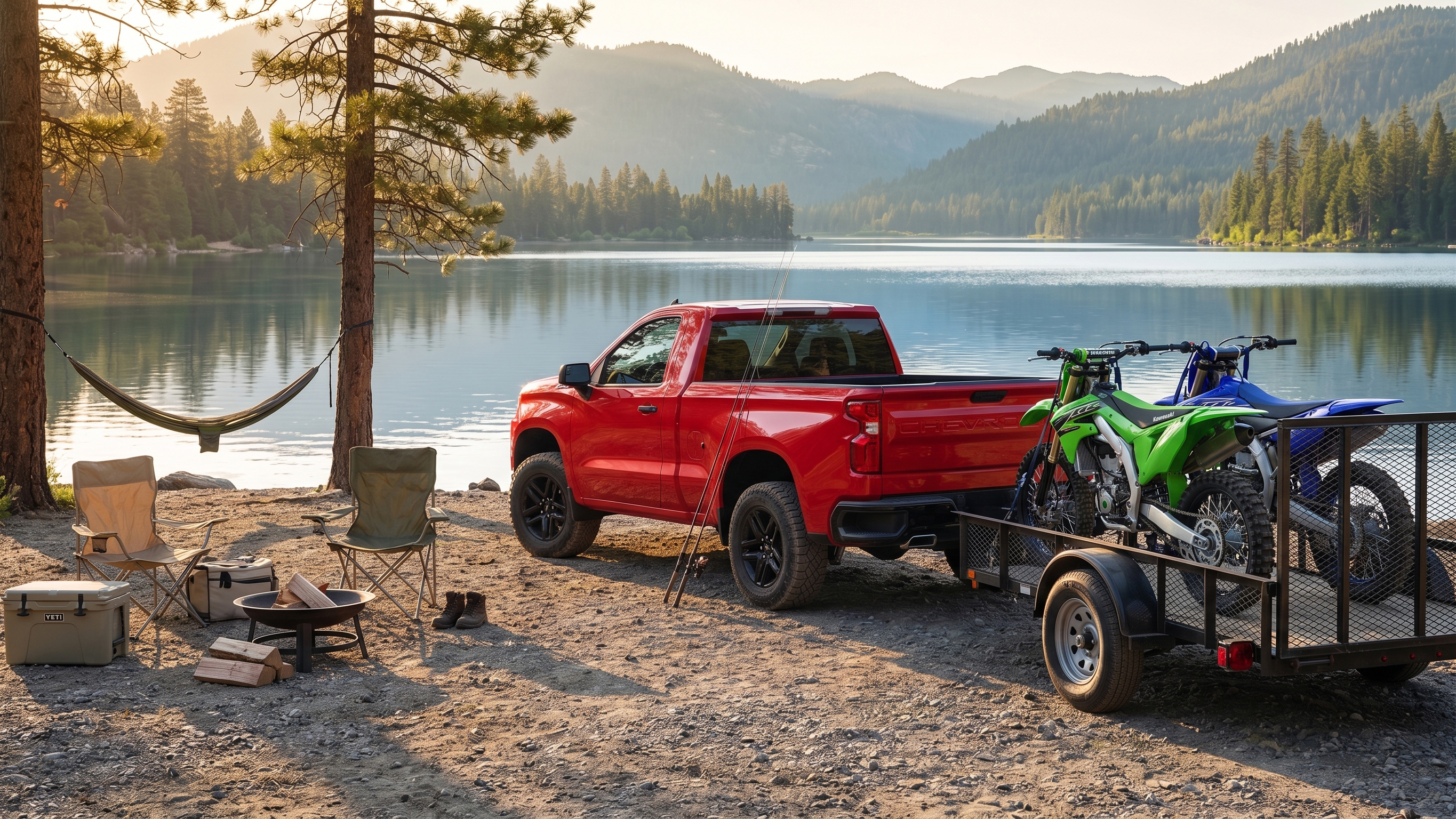
It's the truck that makes riding easier.
You need somewhere to put the bike. Somewhere to put your boots, helmet, tools, fuel and gear. You need enough capability to reach the places you actually ride. And when Saturday morning arrives, you shouldn't need an engineering degree to get everything loaded and hit the road.
That's why choosing a truck for motocross, enduro, trail riding or weekend dirt biking requires looking at pickups a little differently.
From midsize trucks that can carry a bike directly in the bed to full-size trucks capable of towing an enclosed race trailer, here's what dirt bike riders should actually look for.
What Makes a Good Dirt Bike Truck?
Start with how you transport your bike.
Most riders fall into one of three categories:
Bike in the bed. This is the simplest setup. Load the dirt bike using a ramp, secure it properly and go.
Multiple bikes in the bed. Two-bike setups require more planning around bed width, wheel wells, handlebars, tie-down locations and gear storage.
Bikes in a trailer. Once you're transporting several bikes, tools, spare parts and riding equipment—or traveling to races—an open or enclosed trailer becomes increasingly attractive.
Each scenario changes what matters in the truck.
A rider hauling one motocross bike locally may have almost no need for serious towing capacity.
A family pulling an enclosed trailer containing four motorcycles, tools, fuel, spare wheels and camping equipment has a completely different requirement.
That's why there isn't one universally "best" dirt bike truck.
There is a best truck for how you ride.
Can You Put a Dirt Bike in a Pickup Bed?
Absolutely.
It's one of the reasons pickup trucks and dirt bikes have gone together for generations.
Most adult dirt bikes are longer than the floor length of many modern short beds, but that doesn't automatically prevent them from being transported there.
Depending on the truck, bike and loading position, riders commonly transport motorcycles diagonally or with the rear tire resting on the open tailgate.
The important factors are:
-
Bed length
-
Bed width
-
Distance between the wheel wells
-
Tailgate capacity
-
Tie-down locations
-
Bike dimensions
-
Loading angle
-
Securement method
Never assume a bike fits simply because you've seen a similar truck carrying one.
Measure your actual bike and truck.
Bed Length Matters More Than Most Riders Think
Pickup beds have become shorter as crew-cab trucks have become more popular.
That's convenient for passengers but can complicate powersports hauling.
A 5.5-foot bed may work perfectly well for a dirt bike, but the rear wheel may need to sit on the tailgate or the bike may need to be positioned diagonally.
Move to a 6.5-foot bed and you gain considerably more flexibility.
An 8-foot bed offers enormous cargo capacity but comes with a much longer truck.
There isn't necessarily a right answer.
A rider who spends weekdays commuting and weekends carrying one bike may prefer a short-bed crew cab.
Someone routinely transporting multiple bikes and large amounts of equipment may gladly accept the additional length of a longer bed.
Loading Height Matters Too
This is especially relevant when talking about lifted trucks.
A taller truck increases the angle of the loading ramp.
That doesn't mean you can't transport dirt bikes with a lifted truck. Riders do it all the time.
It means you should think about the loading system.
A longer ramp reduces the approach angle compared with a short ramp. Wide loading ramps can provide additional room for walking beside the bike. Some riders use folding ramps that provide substantial deployed length while remaining manageable for storage.
Terrain can help, too.
Positioning the truck near a slight rise can reduce the effective loading height.
The goal isn't to prove you can muscle a motorcycle into a tall truck.
It's to create a loading routine that's controlled, repeatable and safe.
Ford F-150: The All-Around Dirt Bike Truck
For many riders, a full-size half-ton is the sweet spot, and the Ford F-150 is one of the obvious platforms to consider.
It offers multiple cab and bed configurations, substantial interior space and enough capability to transition from bed-hauling duties to trailer towing if your powersports setup grows.
That's important.
You may start with one dirt bike in the bed.
Then a friend starts riding with you.
Then you add another bike.
Then comes the trailer.
Choosing a full-size platform gives you room to grow without immediately moving into heavy-duty truck territory.
For riders who want additional off-road capability, F-150 configurations can also provide a strong foundation for reaching remote riding areas.
And then there's the Raptor.
Ford F-150 Raptor: For Riders Who Need to Reach the Good Stuff
The Ford F-150 Raptor approaches the problem differently.
If your dirt bike adventures regularly involve desert roads, rough access routes and remote trailheads, the Raptor's off-road-oriented suspension and hardware make it especially interesting.
It's not necessary for transporting a motorcycle.
That's not really the point.
The appeal is that the truck itself becomes part of the adventure.
Load the bike, leave the pavement and keep going.
For riders whose weekends revolve around exploring desert and off-road terrain, that combination can make tremendous sense.
Chevrolet Silverado 1500 and GMC Sierra 1500: Excellent Full-Size Options
The Chevrolet Silverado 1500 and GMC Sierra 1500 offer many of the same fundamental advantages as the F-150.
You get full-size bed capacity, available crew-cab space, strong engine choices and enough towing capability for many powersports trailers when properly configured.
They're especially appealing for riders who want one truck to do everything.
Drive it to work.
Load the bike Friday night.
Tow the trailer when necessary.
Take everyone with you.
Go riding.
The Sierra also provides an opportunity to move further into premium-truck territory for riders who want capability without sacrificing interior comfort.
That becomes increasingly valuable when your favorite riding destination is several hours away.
Ram 1500: Comfort Matters on Long Trips
Dirt biking may happen off-road, but you still have to get there.
For riders who regularly travel long distances to motocross tracks, OHV areas or riding destinations, highway comfort deserves consideration.
The Ram 1500 combines full-size capability with a comfortable cabin and suspension setup, making it an attractive platform for riders whose weekends involve significant road mileage.
A crew cab also gives you valuable protected storage.
And dirt bike riders need a lot of it.
Helmet.
Boots.
Chest protector.
Knee braces.
Goggles.
Gloves.
Hydration equipment.
Tools.
Clothes.
You quickly discover that transporting the motorcycle is only half the problem.
Toyota Tundra: A Strong Adventure Platform
The Toyota Tundra is another natural match for riders who want full-size capability with an outdoor and off-road focus.
It offers the space required for dirt-bike duty while maintaining enough capability to transition into trailer towing as your setup expands.
For riders already interested in camping, overlanding and trail exploration, the Tundra can also become the foundation for a broader adventure build.
That's an important consideration.
The best dirt bike truck doesn't have to serve only one hobby.
It can carry the motorcycle one weekend and camping equipment the next.
Ideally, it does both at once.
Toyota Tacoma: Do You Really Need a Full-Size Truck?
Not necessarily.
The Toyota Tacoma demonstrates why midsize pickups remain popular among riders.
A dirt bike isn't particularly heavy compared with the payload demands pickups are designed to handle.
For someone transporting one bike and a reasonable amount of equipment, a properly configured midsize truck can be an extremely practical solution.
Its smaller dimensions can also become an advantage when accessing tight trails, forest roads and remote riding areas.
It's easier to maneuver.
It's easier to park.
And depending on configuration, it may still provide everything a solo rider actually needs.
The trade-off is space.
Start carrying several people, multiple bikes and a mountain of equipment and a midsize truck can begin feeling small quickly.
Chevrolet Colorado and GMC Canyon: Midsize Alternatives
The Chevrolet Colorado and GMC Canyon belong in the same conversation.
They're compact enough to remain maneuverable while offering legitimate pickup-bed utility.
Off-road-focused configurations can be particularly interesting for riders who routinely leave paved roads behind to reach staging areas.
Like the Tacoma, the key question isn't whether a Colorado or Canyon can transport a dirt bike.
It's whether the truck has enough total space for your riding lifestyle.
One rider and one bike?
Potentially excellent.
Four people, several bikes and a weekend's worth of equipment?
You may want something larger.
When Does an HD Truck Make Sense?
An F-250, F-350, Silverado 2500HD, Sierra 2500HD or Ram 2500 is probably unnecessary if your entire powersports operation consists of one dirt bike.
But the equation changes once trailers become involved.
Imagine an enclosed trailer carrying:
-
Four dirt bikes
-
Fuel
-
Toolboxes
-
Spare tires
-
Parts
-
Riding gear
-
Generator
-
Pressure washer
-
Camping equipment
-
Food and water
Now you're building something closer to a mobile race shop.
That's where an HD truck begins to make more sense.
The additional towing, payload and heavy-duty hardware provide room for the entire operation to grow.
For serious racers, riding families or people who participate in multiple powersports, an HD truck can become the foundation for everything.
Open Trailer vs. Enclosed Trailer
Eventually many riders stop putting motorcycles in the bed and start towing them.
An open trailer is relatively simple.
It's easy to load, doesn't require enormous towing capacity and leaves the truck bed available for equipment.
An enclosed trailer changes the equation.
Now your bikes and gear are protected from weather and road debris. You can organize tools and equipment inside. The trailer can potentially become a changing area, workshop or basic camp setup.
For competitive riders, that can be a major upgrade.
But enclosed trailers are heavier and create considerably more aerodynamic drag.
The larger the trailer becomes, the more important proper truck selection becomes.
Half-Ton or Heavy Duty?
For most recreational dirt bike riders, a properly configured half-ton provides an enormous amount of capability.
An F-150, Silverado 1500, Sierra 1500, Ram 1500 or Tundra can carry bikes in the bed and tow many common powersports trailers.
Move into larger enclosed trailers, substantial cargo or multiple powersports machines and HD trucks become more attractive.
Don't buy based solely on maximum advertised towing capacity.
Look at:
Payload.
Trailer weight.
Tongue weight.
Gross Combined Weight Rating.
Axle ratings.
And the ratings for the actual truck you're considering.
The goal isn't to find a truck that can technically move the trailer.
It's to find a truck appropriately matched to it.
Crew Cab or Extended Cab?
For dirt bike riders, we'd lean toward more interior storage whenever practical.
Why?
Because riding gear gets expensive.
Leaving helmets, boots, goggles, electronics and other equipment exposed in the bed isn't always ideal.
A crew cab gives you substantial lockable, weather-protected storage.
Fold the rear seats up and suddenly you have room for riding bags, helmets, tools and other equipment without filling the bed.
If you're traveling with friends or family, the answer becomes even easier.
Get the extra cab space.
The Dirt Bike Truck Bed Setup
A good bed setup can transform the experience.
You don't need to turn the truck into a professional race transporter, either.
Start with the fundamentals.
Quality Tie-Down Points
Secure attachment points are essential.
Motorcycles need to remain stable during acceleration, braking, cornering and rough-road travel.
Wheel Chocks
A properly installed motorcycle chock can help locate and stabilize the front wheel during loading and transport.
Quality Tie-Downs
Use motorcycle-appropriate straps and inspect them regularly.
Soft loops can also help create secure attachment points without unnecessarily damaging handlebars or other components.
A Proper Loading Ramp
Don't make the ramp an afterthought.
Choose something rated for the job and long enough for the truck's loading height.
This becomes even more important with lifted trucks.
Bed Protection
Bedliners help protect the truck from boots, stands, tools, ramps, fuel cans and everything else that accompanies riding.
Lockable Storage
A lockable bed box can be extremely valuable for tools, spare parts and equipment.
Just remember that the box consumes bed space that might otherwise be needed for the bike.
Plan the entire layout before installing permanent accessories.
Don't Forget Fuel
Dirt bikes frequently mean carrying additional fuel.
Treat fuel storage seriously.
Use containers designed and approved for fuel, secure them properly, keep them upright and follow applicable transportation and storage requirements.
Don't allow fuel containers to roll freely around the bed.
And don't treat the passenger compartment as convenient storage for gasoline.
A Lifted Truck Can Be an Excellent Dirt Bike Platform
There's a natural relationship between lifted trucks and powersports.
Both are about going farther than the pavement.
A properly built lifted truck can provide additional ground clearance and off-road capability when accessing remote staging areas, desert terrain and rough trailheads.
But modifications should still respect the truck's intended workload.
If you're towing, pay attention to hitch height and trailer attitude.
If you're loading motorcycles into the bed, consider the increased loading height.
If you've changed wheels and tires, make sure their load ratings remain appropriate.
A good build improves the truck for your lifestyle rather than compromising the things you need it to do.
So What's the Best Truck for Dirt Bikes?
It depends on the rider.
For a solo rider carrying one dirt bike, a Tacoma, Colorado, Canyon or other properly configured midsize truck may provide everything necessary.
For one or two bikes plus substantial gear, full-size half-tons such as the F-150, Silverado 1500, Sierra 1500, Ram 1500 and Tundra offer an excellent balance.
For riders who regularly access remote off-road terrain, off-road-focused trucks such as the Raptor and other trail-oriented configurations become particularly attractive.
For families, racers and riders pulling larger enclosed trailers, an F-250, Silverado 2500HD, Sierra 2500HD, Ram 2500 or larger HD platform may make more sense.
The best dirt bike truck isn't determined by the badge on the grille.
It's determined by what happens every time you load up and go riding.
Build Around the Way You Ride
Think beyond the motorcycle.
Where do you ride?
How far do you travel?
Do you ride alone?
Will you eventually own another bike?
Do you camp?
Race?
Tow a trailer?
Carry tools and spare parts?
Travel into remote terrain?
Those questions tell you far more about the truck you need than horsepower alone.
Your dirt bike is built to leave the pavement behind.
Your truck should make getting it there the easy part.
Find Your Next Powersports Truck at Lifted Trucks
Whether you're hauling a motocross bike in the bed, towing an enclosed race trailer or building the ultimate truck-and-dirt-bike adventure setup, Lifted Trucks can help you find a truck that fits the way you ride.
Explore professionally built Ford, Chevrolet, GMC, Ram, Toyota and other custom trucks with the capability, utility and style to complement your powersports lifestyle.
From midsize adventure platforms and full-size half-tons to heavy-duty tow rigs, there's a truck for nearly every kind of rider.
And your location doesn't have to limit your options. Lifted Trucks offers nationwide shipping, helping customers across the country shop our inventory.